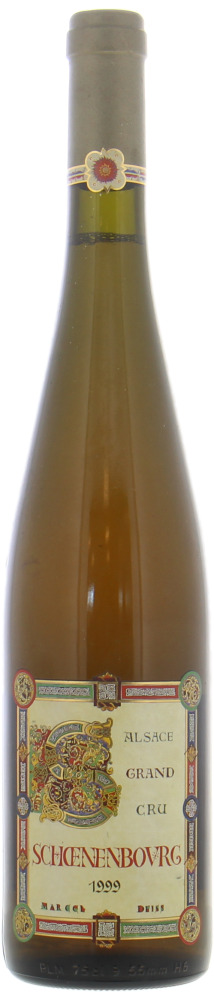

| Classification | Cru Classe |
| Type | White |
| Producer | Marcel Deiss |
| Wine | Schoenenbourg Grand Cru |
| Vintage | 1999 |
| Country | France |
| Region | Alsace |
| Grape | Riesling |
| Volume | 0,75 |
| Condition | Perfect |
| Label | Perfect |
| Stock | 1 |
The 1999 growing season in Alsace was warm and generous, with botrytis appearing late in the season and acidity slightly lower than in the cooler vintages of 2001 and 2002. For Marcel Deiss of Bergheim, this meant ripe, expressive fruit from the slopes of the Schoenenbourg above Riquewihr. The Riesling here is full-bodied rather than pungent. This is a wine for weight, not tension.
After more than 20 years, the nose is unmistakably ripe Riesling: petrol, beeswax, candied citrus zest and dried apricots. On the palate, the marl is salty, almost gypsum-like: the 1999 is more fleshy than a typical Schoenenbourg, with warm season stone fruit and honeyed depth, but lifted by long aging on the lees.
100% Riesling. Given Jean-Michel Deiss's famous claims about composition, why not make a vineyard blend - the 1999 Grand Cru rules still dictate bottling by varietal, and the Keuper marl and steep south-facing slopes of Schoenenbourg are ideal for Riesling. Riesling is the perfect match. Voltaire owned vineyards here in the 18th century. He knew what he was doing.
Drink from now until about 2030; the 1999 wine is fully ripe and shows a tertiary side of petrol, honey and dried fruit, but Schoenenbourg Rieslings made from marl are exceptionally persistent. Store at 12-14°C, bottled for short-term aging. Store vertically, and for long-term aging, store horizontally. Do not expect further development. Expect graceful aging.
Almost every Alsace producer puts the grape variety on the label. Marcel Deiss does not, and that has been the case since the late 1990s, when the family dropped varietal names in a region that had built its reputation on Riesling, Gewurztraminer and Pinot Gris. The estate farms 32 hectares around Bergheim, in the Ribeauvillé fault zone, where soils change from one plot to the next like a mosaic. Everything is biodynamic, yields are low, and the vineyards are planted by complantation: 13 Alsatian varieties growing intermixed, picked together, pressed together, fermented together. No blending afterwards. Writing for James Suckling, Stuart Pigott called the Deiss family pioneers of field blends and has been visiting Bergheim since the late 1980s. Grand Crus include Schlossberg, Schoenenbourg, Altenberg de Bergheim and Mambourg.
Schoenenbourg is located on the southern slope above Riquewihr, at an altitude of 265-380 meters. The soil is important: Keuper marl with gypsum and dolomite, often mixed with Vosges sandstone, over which the Muschelkalk limestone rises. Why it's important. Gypsum retains moisture even in dry summers (Alsace is one of the driest regions in France thanks to the rain shadow of the Vosges), and marl gives Riesling its salinity. Voltaire owned vineyards here. He had his reasons.
Deiss keeps yields low and allow the grapes to speak. After pressing, the wine is fermented with indigenous yeasts in old wooden foudres (large neutral barrels that give texture without retaining oak flavor). Fermentation takes place slowly, sometimes over several months. The wine is then left to age for a long time to develop a creamy middle of flavor. The wine is neither cleaned nor filtered before bottling. Since 1998, the vineyards have been treated biodynamically, which is confirmed by Demeter certification.
The salinity and acidity of Schoenenbourg pairs well with fatty and rich dishes. Examples:
Serve at 10-12°C. Does not require decanting, but the cork should be removed 30 minutes before serving.
With track & trace code