
| Classification | Cru Classe |
| Type | Red |
| Producer | Verite |
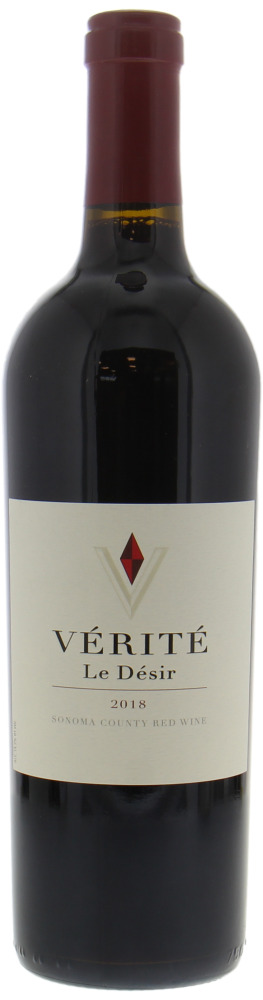
| Wine | Le Desir |
| Vintage | 2018 |
| Country | United States |
| Region | California |
| Appellation | Sonoma County |
| Grape | Cabernet Sauvignon, Merlot, Cabernet Franc, Bordeaux Blend |
| Volume | 0,75 |
| Condition | Perfect |
| Label | Perfect |
| Drinkable | -2050 |
| Stock | 1 |
The 2018 growing season in Sonoma County was one that winemakers have been talking about for years. A long, cool, even ripening period. No heat, no smoke and plenty of aging time. For Verité's Le Désir, this means that the grapes have reached phenolic ripeness without losing the floral and herbal notes that characterize the Cabernet Franc varietal. The 2018 Le Désir is more restrained and flavorful than warmer vintages, with savory notes.
Composed of 82% Cabernet Franc, 12% Merlot and 6% Malbec, the 2018 Le Désir was aged for 16 months in 100% new French oak. Deep garnet-purple in color, it is a little closed to begin, soon unfurling to offer glimpses at notes of kirsch, raspberry preserves and mulberry scents, plus hints of cedar chest, crushed rocks, bay leaves, Sichuan pepper and lavender with a waft of sandalwood. The medium to full-bodied palate has tons of freshness to support the melange of preserved red and black fruits, textured by grainy tannins, finishing with a lingering peppery kick. It may require just a little more time to come around than the La Joie and La Muse, and then I suspect this beauty is going to reward the patient.
Blackberry, violet and crushed stone on the nose. Pure fruit, but reserved and tensioned. Full-bodied with firm, tight tannins and a long finish. Some tightness. The tannins spread across the palate, so integrated and toned yet chewy. A structured and almost steely wine. 82% cabernet franc, 12% merlot and 6% malbec.
The first thing that catches the eye is the nose. Violet, crushed raspberry and tobacco leaf. Black cherry, graphite and pencil sharpener that Cabernet Franc fans will recognize at a glance. The flavor is fine rather than muscular, the tannins polished with new oak but still quite firm. The savory, iron-tinged finish brings it all back to Saint-Émilion. It's drinkable now if you let it air; it'll be even better in five years.
Cabernet Franc leads the way in this wine, and merlot, cabernet sauvignon and a small amount of Cabernet Franc-complementary varieties usually make up more than half the blend. So why make Sonoma wines with Cabernet Franc at their core? Because Pierre Seillan wanted to make a right bank wine that could rival La Joie and La Muse. The Franc brings violet aromas and graphite notes. Merlot fills out the middle part of the palate. Cabernet Sauvignon and Malbec give structure and color.
Drink between 2026 and 2050; 2018 has the acidity and tannins to age well, but Cabernet Franc-dominated wines tend to come into their own earlier than Cabernet-dominated blends. Store bottles horizontally at 12-14°C, away from light. Decant one hour before serving.
Verité means "truth" in French, and the project is based on one premise: Can Sonoma County make Bordeaux-style wines without compromising itself? Pierre Seillan, who came to California in 1998 after decades spent in Gascony, Loire and Bordeaux, thinks so. Jess Jackson, who co-founded the winery with him, agrees with him. More than 50 small plots in the Alexander Valley, Knights Valley, Chalk Hill and Bennett Valley are fermented separately. Pierre's daughter, Hélène Seillan, now works with him. Le Désir is the most distinctive of the three flagship wines.
Le Désir is not a single vineyard wine. It is harvested from hillside plots scattered across Sonoma's four appellations, each chosen for what it yields to Cabernet Franc. Why it matters. Because Cabernet Franc is very finicky. Too warm and it loses its flavors. If it's too cold, it becomes pungent. Verite plots range from 60 meters above sea level in the Chalk Hill area (volcanic ash, fog effect) to 700 meters above sea level in parts of the Alexander Valley. Knights Valley is located on volcanic soils at the foot of Mount Saint Helena. Bennett Valley receives cool air from Crane Canyon. Different temperatures, different maturation periods, and different flavors can form the basis for a blend.
Fragmentation is the decisive factor here: each of the 50-plus sites is harvested separately, fermented separately and aged separately in French oak barriques (225-liter barrels from Bordeaux). The proportion of new oak is usually high, often 80-100%, due to the high concentration of fruit due to the hillside location. Seillan and his daughter Hélène taste hundreds of components before deciding on the final blend. Harvest decisions are made based on flavor, not sugar content readings. Lab values are confirmatory, not determinative. Aging prior to bottling is approximately 20 months.
Cabernet Franc's herbaceous and floral flavors are suited to savory, deep dishes as well as protein dishes. Try it with:
Serve at 17-18°C. Decant one hour before serving or longer if drinking young.
With track & trace code