
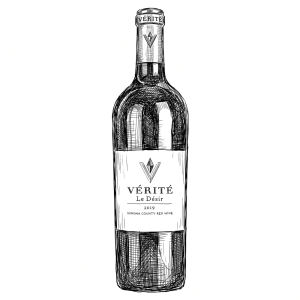
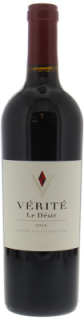
Le Desir
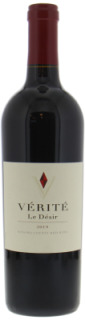
Verité's Le Desir is the leading Cabernet Franc wine in Sonoma's trio of Bordeaux blends and the closest in style to St. Emilion. This is because Cabernet Franc rarely takes the lead in California. Most producers treat Cabernet Franc as a blending grape, a useful but secondary grape. At Verité, Cabernet Franc is at the center of attention.
It's a wine that sits between the right bank of Bordeaux and the warm, sun-drenched hills of Sonoma County. The French winemaker behind the project, Pierre Seillan, makes Le Desir from dozens of small plots in Alexander Valley, Knights Valley, Chalk Hill and Bennett Valley. The result is a wine that drinks like Bordeaux but tastes unmistakably Californian. This tension is key.
About Verite
Jess Jackson (aka Kendall Jackson) met Pierre Seylan in the mid-1990s and convinced him to start something new in California; they founded Verité in 1998. Seillan still makes wine along with his daughter Hélène.
What makes Verité unique? Seillan makes wine from more than 50 microplots ("microcrops" is a term he coined) located in four Sonoma appellations. Each is fermented separately to create the hundreds of elements needed for blending. This multi-AVA approach sets Verité apart from the iconic cabernets from a single vineyard in Napa.
History & Heritage
Pierre Seillan came to California with a lot of experience. He had spent decades with Bordeaux varieties: his family's Armagnac estate, Château de Targé in Saumur-Champigny, and several châteaux in Bordeaux. When Jess Jackson invited him to Sonoma in 1998, he arrived with a fully formed philosophy.
Why is this important to Le Desir today? Because the wines are not made in the California winemaking tradition, but in the French manner. Quite the opposite. Seillan's years of Loire cabernet from France's Saumur-Champigny region still live on in this bottle. Jackson passed away in 2011, but the project continued under the Jackson Family Wines label without changing direction.
Terroir & Climate
Le Desir is sourced from more than one vineyard. Its grapes are harvested from 12 vineyards located in the Alexander Valley, Knight's Valley, Chalk Hill and Bennett Valley at elevations ranging from 60 to nearly 2,300 feet above sea level. Mr. Seillan calls his approach "droit du sol" (right of the soil).
Why is this important for Cabernet Franc? Because Cabernet Franc is demanding when it comes to ripeness. Harvest it too early and it turns peppery and green. Harvesting too late in hot areas will result in the loss of the flavors that make Cabernet Franc so interesting. Sonoma is blessed with this combination. The warmer Alexander and Knights valleys promote ripening, while the cooler Bennett Valley and fog-prone Chalk Hill preserve acidity and flavors. Seillan blends all these components.
Grape Varieties
Le Desir is made primarily from cabernet franc, which, depending on the vintage, typically makes up 50-70% of the blend. The rest is a combination of merlot and cabernet sauvignon. Why cabernet franc?
Because in the warmer climate of Sonoma, Cabernet Franc loses the herbaceousness and foliage it exhibits in the Loire and takes on darker fruit, plum and even chocolate without losing its signature violet flavors and graphite lift. Merlot completes the middle part of the palette, while Cabernet and Petit Verdot lend structure.
Winemaking
An important decision for Verité is to keep everything as separate as possible. Each microplot is harvested and fermented in a separate container. Seillan then selects the level of oak and toast for each batch. The wine is typically aged in 100% new French oak for approximately 20-24 months before being bottled unfiltered.
There is a great deal of new oak barrels. Why does this work? Because the concentration of fruit from low-yielding plots contributes to it. Hélène Seillan does not use analytical results as a trigger, only as a reference. The blend itself is extracted from hundreds of components and assembled later.
Tasting Notes
The first thing that catches the eye is the perfume. Le Desir leads with violets, crushed raspberries and black currants, moving into darker territory of plums, graphite and curls of pipe tobacco. Merlot and Cabernet Sauvignon round it out with new oak cassis and dark chocolate.
In the mouth, the tannins are fine and supple. The wine is rich, something you wouldn't expect from a Cabernet Franc-dominated wine. The finish is graphite and cedar, backed by savory, almost iron notes. Most vintages need at least five to seven years before they begin to loosen up. Patient drinkers will be rewarded.
Food Pairing
The tannins and dark fruit call for protein and a touch of char. Some specific suggestions:
- Grilled ribs, simply seasoned, the fat softens the tannins.
- Whole roast lamb with rosemary and garlic, the herbs echoing the cabernet franc.
- Duck breast with blackberries and cherries.
- Aged hard cheeses such as Comte and Cheddar.
Serve at 17-18°C. Avoid fish, light poultry and salads, which will be overwhelmed by the weight of the wine.
Serving Suggestions
Le Desir at 16-18°C. Decant young wine for at least 90 minutes; for bottles 15 years old or more, 30 minutes in a decanter is sufficient. Use a large Bordeaux glass to bring out the flavors.
Vintages
Le Desir is remarkably consistent, which is part of the point of blending in multiple AVAs. Weaker areas in one valley can be balanced by stronger areas in another valley. Nevertheless, the individuality of the vintage is preserved.
Warmer years are more full-bodied, with plum fruit and a rich middle. Cooler years are characterized by more lift, graphite, more overt cabernet franc notes and longer cellar time. To drink it soon, look for bottles that are at least 10 years old. Cool, well-structured vintages deserve patience when stored in the cellar. Older wines tend to cost more, which is justified given the degree of aging.

Cellaring Potential
Most Le Desir vintages reach their goal eight to fifteen years after harvest, and the best of them can easily age for 20 to 25 years. The combination of Cabernet Franc's acidity, the firm tannins of Cabernet Sauvignon and Petit Verdot, and the extensive use of new oak give the wine real structure. Store horizontally in a light protected place at 12-14°C. Aging deepens the aromas and integrates the tannins.
FAQ
Is Le Desir a Bordeaux wine?
No. It is not a Bordeaux wine. It is produced in Sonoma County, California, but in a right bank Bordeaux style, closer to St. Emilion than Pauillac.
How is it different from La Joie and La Muse?
La Joie is dominated by cabernet sauvignon (Left Bank style), La Muse is dominated by merlot (Pomerol style), and Le Desir is dominated by cabernet franc (St. Emilion style).
How long should it be stored?
At least eight years from the time of harvest. The best vintages can be aged for at least 20 years.
Is it worth its price?
Production is low, around 1,500-2,000 cases per vintage, and demand is steady. As an investment and as a drinking wine, the value of this wine is well maintained.
