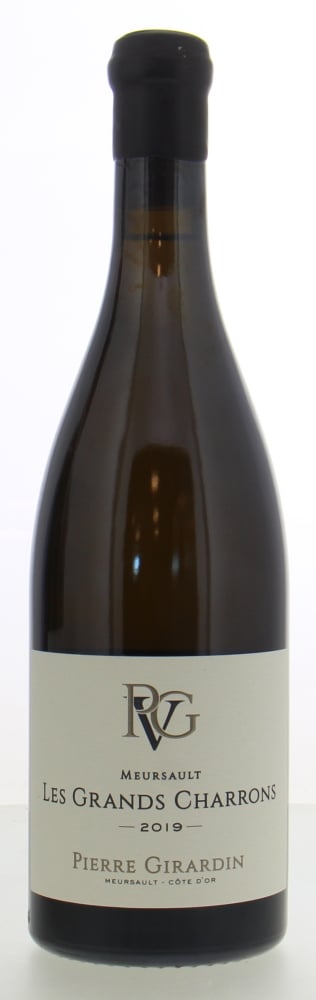

| Classification | Cru Classe |
| Type | White |
| Producer | Pierre Girardin |
| Vintage | 2019 |
| Country | France |
| Main region | Burgundy |
| Region | Côte de Beaune |
| Appellation | Meursault |
| Grape | Chardonnay |
| Volume | 0,75 |
| Condition | Perfect |
| Label | Perfect |
| Drinkable | 2024-2038 |
| Stock | 0 |
The 2019 growing season in Burgundy was hot and dry, with spring frosts and summer drought significantly reducing yields. For Meursault Les Grands Charrons from Pierre Girardin, this meant low yields but concentrated fruit and acidity that persisted better than one might expect. You can expect the richness and intensity of cooler years from this northern Meursault lieu-dit, but with the same tension that Pierre knows how to maintain.
First impressions. Ripe fruits, white peach and pear, layered with limestone rubble and toasted hazelnuts; there's the warmth of 2019 in the heaviness of the palate, but something salty and dense emerges on the finish. There are faint flavors of brown butter, but not old-fashioned buttery flavors. It's drinkable now if you give it some air, but I think a couple more years of aging will draw out the mid-palate.
So why does Les Grands Charrons Chardonnay taste different from Puligny further down the road? Soil. Meursault is rich in clay, which gives the grapes fleshiness and roundness without the laser-like firmness of neighboring Chardonnay; in hot 2019, the clay is even more important because it retains water and keeps the vines from shutting down.
100% Chardonnay.
Drink between 2025 and 2032; the concentration from the low 2019 vintage gives this wine real density, and the retained acidity means the wine won't go flat early. Store at a stable temperature of 12-14°C. With time, the primary fruit aromas will give way to notes of honey, hazelnut and oatmeal characteristic of Meursault.
Pierre Girardin is one of Burgundy's most talked-about young estates, run from Meursault by Pierre-Vincent Girardin, a 13th-generation winemaker. His father Vincent sold the commercial business in 2011 but kept 4.5 hectares of top plots for his son. Pierre-Vincent released his first vintage in 2017, at 19, and the estate now covers more than 14 hectares across the Côte de Beaune and Côte de Nuits, plus around 6 hectares in the Jura. Farming is organic with biodynamic work in the vineyard. Yields stay low. For the whites, he had François Frères make special 456-litre barrels to keep new-oak influence down. Reds use whole bunches and gentle extraction for silky tannins. Each cuvée averages around 1,400 bottles.
Les Grands Charrons is located north of Meursault, near the border with Volnay and Monthélie. The soils are clay-limestone, with the limestone providing the sharpness and the clay the body. What is interesting about this lieu-dit is its slightly cooler location compared to the climate of southern Meursault areas such as Charmes and Perrières. In warmer years, this cooler location works to its advantage. It prevents the wines from gravitating towards heaviness, which is exactly what Pierre Girardin is trying to achieve.
Pierre commissioned François Frères to custom-build a 456-liter barrel for his white wines. Why a larger one: less contact area per liter means less influence of new oak, which is very important. He wants the Meursault to have a Meursault flavor, not wood. The wine is aged for 12 months in barrels on the lees, fermented with indigenous yeasts and bottled without fining or filtration. The use of new oak is negligible, about 15-20% for Villages wines. The result is transparency, mineral sharpness and freshness.
The richness of this wine pairs well with bold, textured dishes, but not with heavy sauces that will destroy the minerality. Try it with:
Serve at 12-13°C. Over-chilling in the refrigerator will mute the wine's aromatics.
With track & trace code