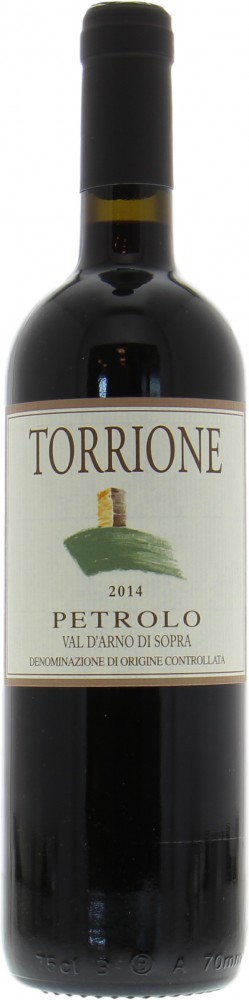

| Classification | I.G.T. |
| Type | Red |
| Producer | Petrolo |
| Wine | Torrione |
| Vintage | 2014 |
| Country | Italy |
| Region | Tuscany |
| Grape | Cabernet Sauvignon, Merlot, Sangiovese |
| Alcohol % | 14% |
| Volume | 0,75 |
| Condition | Perfect |
| Label | Perfect |
| Stock | 47 |
2014 was a challenging vintage for most of Tuscany. The weather was cool and rainy, and the Sangiovese grapes did not receive the necessary amount of sunlight. However, at Petrolo, located in the hilly terrain between Florence and Arezzo at an elevation of 250–500 meters above sea level, the cool climate characteristic of this winery proved to be more suitable this year than in many other regions. “Torrione 2014” has a fresher and lighter flavor compared to more powerful vintages; it is dominated by notes of red berries rather than black ones, and it possesses a corresponding acidity.
A refined and silky rendition of this wine with pretty berry, citrus and light chocolate. Medium body. Chilled and delicious JS
Price per 6 bottles €111,-
(€18,50 per bottle)
The aroma of sour cherries unfolds first, followed by notes of dry herbs, a barely perceptible hint of leather, and a light touch of tobacco. This is the typical style of a Sangiovese from a cool year: Merlot softens the mid-palate, while Cabernet Sauvignon lends the wine structure. The tannins are noticeable but not heavy; they create a sensation of “grip” rather than “chewiness.” The finish has umami, and it features a subtle earthy aroma characteristic of Sangiovese grown at a sufficient altitude above sea level, which helps preserve the acidity. The wine is ready to drink now; there’s no need to wait.
Sangiovese is the main component of this wine, so “Torrione” is not a Bordeaux-style blend but a Sangiovese-based blend. Merlot adds body to the wine and softens its sharp edges. Cabernet Sauvignon contributes structure and aromas of dark fruit. In cooler years, such as 2014, the proportion of Merlot becomes more significant than usual: it prevents the Sangiovese from becoming overly “delicate” and helps maintain the wine’s balance.
The optimal drinking window is from now until approximately 2030. The 2014 vintage is not suited for long-term aging: it lacks the concentration of fruit notes required for aging beyond two decades. However, the acidity is sufficient to ensure the wine’s integrity. Store at a temperature of 12–14 °C. Tertiary aromas (leather, dried herbs, tobacco) have already emerged, but this, too, is part of the wine’s charm.
Petrolo is located in Valdarno di Sopra. This is a corner of Tuscany that many wine lovers would be hard-pressed to find on a map. In 1716, Cosimo III de’ Medici designated this part of the Arno River valley as one of Tuscany’s four best wine-growing regions. However, this place was subsequently forgotten. Luca Sanjust, a former artist turned winemaker, took over the family business and revived this winery. We offer “Petrolo” wines precisely because no other producer creates such a unique Sangiovese at this altitude. This winery uses organic farming methods: neither irrigation nor plowing is practiced here, and the entire area is covered with natural grass.
This winery borders the southeastern edge of Chianti Classico but is situated at a higher and cooler elevation. The vineyards stretch from 250 to 500 meters above sea level, and the surrounding forests further lower the temperature. The soil consists of marl, sandstone, and shale; it is well-drained and rich in minerals. It is precisely this elevation above sea level and the forest surroundings that speak for themselves. The nights are cool, and ripening occurs slowly, which accentuates the grapes’ acidity. This is precisely why “Petrolo” wines, even in warm years, have a fresher taste than most Tuscan red wines. In the cool year of 2014, this same vineyard produced a wine characterized not by fragility, but by a robust structure.
“Torrione” is aged not in small barriques, but in traditional large botti. This is an important decision. Botti (large barrels made of neutral oak) allow the wine to “breathe,” harmoniously blending aromas of vanilla and toasted bread with the character of the Sangiovese grape without overpowering it. Barriques are used for “Galatrona,” while botti are used for “Torrione.” Yields across the entire estate are extremely low—20–25 hectoliters per hectare—which allows for a concentrated fruit flavor. Neither irrigation nor plowing is practiced; organic farming is used throughout the estate. Work in the cellar is focused on preserving what the vineyard has produced in its original form.
Here, it is the Sangiovese’s acidity that determines its food pairing potential. This acidity cuts through richness and highlights the rich flavors of the dishes. Here are a few dishes that pair well with it:
Serve at 16–18 °C. If you plan to drink the wine immediately, let it “breathe” in a decanter for about 30 minutes.
With track & trace code