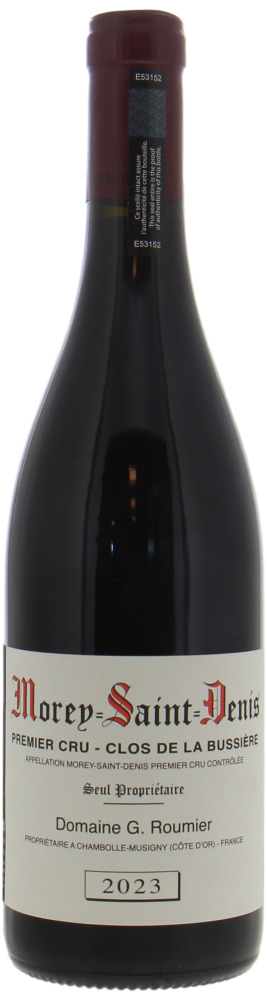
| Classification | Cru Classe |
| Type | Red |
| Producer | Georges Roumier |
| Vintage | 2023 |
| Country | France |
| Main region | Burgundy |
| Region | Côte de Nuits |
| Appellation | Morey Saint Denis |
| Grape | Pinot Noir |
| Alcohol % | 13.5% |
| Volume | 0,75 |
| Condition | Perfect |
| Label | Perfect |
| Drinkable | 2027-2042 |
| Stock | 0 |
The 2023 growing season in Burgundy was warm but not extreme conditions, resulting in a good harvest. Harvesting began in late August and early September. For Georges Roumier's Monopole, located in Morey St. Denis near Chambolle, this meant that the fruit remained fresh and moderately alcoholic, in marked contrast to the dense 2022 and concentrated 2020. Clos de la Bussière 2023 is a typical expression of the region. The structure is firm, but with the intensity that Roumier fans are looking for.
The 2023 Morey-Saint-Denis 1er Cru Clos de la Bussière offers up aromas of cherries, raspberries and plums, along with hints of baking chocolate and spices. Medium to full-bodied, lively and layered, it's rich and charming, with a rather open, gourmand profile for a wine that's sometimes among Roumier's more structured bottlings. At 13.8%, this is one of the higher alcohol wines in the range, as is often the case.
60% whole bunch. 20% new oak. Cask sample.
Mid-deep ruby. Raspberry, red cherry and a little woodland berry on the palate. A slightly sour freshness to the acidity gives this a juicy earthiness. Moderately pronounced, firm tannins. (MH)
A fuller and possibly brighter purple. First picked. There is a direct energy here with some blueberry fruit, this is evidently ripe but has retained its shape very well, with just a few tannins at the finish still to resolve. From another barrel much livelier, with redder fruit. This will deliver.

First red cherries, then something darker, with stony fruit and crushed stone nuances. Clos de la Bussière is rarely the prettiest wine in Roumier when young, and 2023 continues that trend. The acidity and slightly stemmy flavors (characteristic of Roumier, which is made from whole clusters) are wrapped in fine but firm tannins. The mid-palate is fresher than the 2022 and the finish is savory rather than fruity. Patience is needed, but the structure is there.
100% Pinot Noir. So why does Bussière taste different from Chambolle Roumier? The clay and pebbly soils of this east-facing site give Pinot Noir more grip, more savory and less floral appeal. Same grapes, but harder tannins. This is the touch of Bussière and the reason why it ages longer than the other premier crus of the village.
Drink between 2030 and 2045. The tannins of Clos de la Bussière 2023 are still tightly bound, and the freshness of the vintage suggests a long, slow evolution rather than early opulence. keep at a constant temperature of 12-14°C. Around the 10th year, saline and earthy nuances appear in the wine and expect a change in the red fruit character.
Domaine Georges Roumier is located in Chambolle-Musigny, and its wines are among the most sought-after in Burgundy. What sets Roumier apart: Christophe Roumier, who has been at the helm of the estate since the early 1980s, is meticulous about terroir. New oak is rarely used, and fermentation temperatures do not exceed 32°C to preserve the flavors. The result is a wine that is fruity in its youth but can age for decades. Best of Wines considers Roumier a must-have wine for serious Burgundy collectors.
Clos de la Bussière is a 2.59 hectare walled vineyard ("Clos") that is monopole, meaning Roumier owns the entire area. It is located in the southern part of the Morey-Saint-Denis, near Chambolle-Musigny and close to Bonnes-Mares. Why it is important. The soil here is more iron-rich red clay than in other Roumier vineyards, and underneath is limestone. The slopes face east, at an altitude of about 270 meters. This clay gives Bussière its signature structure and flavors.
The decisive choice here is the restrained use of new oak. Bussière uses about 25-30% French barriques (small 225-liter barrels), which is much less than most producers use for their Premier Crus. The aging time is 16-18 months. Whole cluster fermentations in different vintages use only autochthonous yeasts and punchdown is done by hand. The temperature is kept below 32°C during fermentation. This is key to preserving the flavor of pinot noir rather than boiling it down.
Bussière has more grip and savory weight than Roumier's Chambolle. Taste:
Serve at 16-17°C. Decant young wines one hour before serving.
With track & trace code