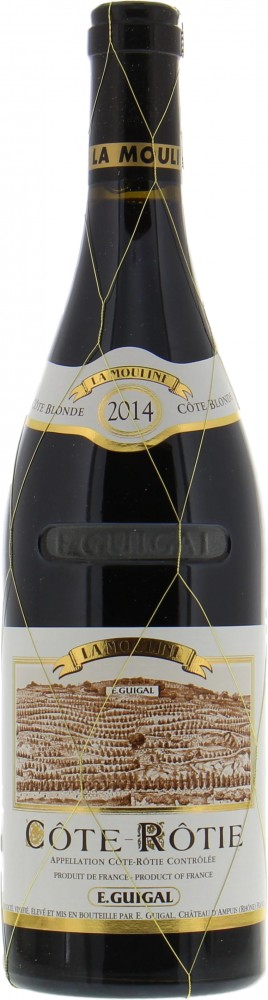
| Classification | Cru Classe |
| Type | Red |
| Producer | E.Guigal |
| Wine | La Mouline |
| Vintage | 2014 |
| Country | France |
| Region | Rhone |
| Appellation | Côte-Rôtie |
| Alcohol % | 13% |
| Volume | 0,75 |
| Condition | Perfect |
| Label | Perfect |
| Drinkable | 2020-2045 |
| Stock | 0 |
The 2014 growing season in the Northern Rhone was a busy one for winemakers. A cool and wet summer worried producers, but dry and warm days in September saved the vineyard. For E. Guigal's winery La Mouline, established on old vines of Syrah and Viognier in the Côte Blonde, this late salvation resulted in lighter, more flavorful wines. This was not a blockbuster year. Nevertheless, it is an elegant and flavorful expression of this single vineyard.
Still aging in barrel, the 2014 Cote Rotie La Mouline is really charming, sexy stuff. Soaring florals emerge from the glass, accompanied by notes of dark fruit, espresso and grilled meat. Silky and seductive, it should drink well young yet be capable of developing for 20 years.
La Mouline 2014 leads the nose, and the viognier speaks for itself. Violets, apricot rind, smoked bacon, dark cherry and raspberry with hints of white pepper. The character of Côte Blonde is evident on the palate. Silky rather than firm, with fine-grained tannins and a flavorful, almost floral finish, less dense than the 2015 and 2016, but with more lift and immediacy. This is a vintage that will reward those who value flavor over power.
Drink from about 2024 to 2038; the 2014 is a more delicate La Mouline, so don't expect it to age 25+ years like the 2015. The Viognier component (about 11%) and long aging in new oak barrels give it structure, but the fruitiness is best at the mid-stage of cellaring at 12-14°C.
Ampuis is a small village on the right bank of the Rhône, and Etienne Guigal turned it into the reference point for Côte-Rôtie. Étienne Guigal started the estate there in 1946 after fifteen years working at Vidal-Fleurie, and the family bought that company outright in 1984 (a neat reversal). Today the estate owns around 45 hectares, roughly half in Côte-Rôtie, the rest spread across Condrieu, Saint-Joseph, Hermitage and Crozes-Hermitage. But Guigal is also the valley's leading merchant, handling about 40 per cent of all Côte-Rôtie and around 45 per cent of Condrieu, with total production near seven million bottles a year. Marcel Guigal runs it with his son Philippe, chief winemaker since 1997. Late harvesting is the house habit. They usually pick among the last in the appellation.
La Mouline is produced at Côte Blonde, where granite and gneiss lie beneath a light, sandy, siliceous topsoil. The east- and southeast-facing terraces receive morning sunlight, and the stone walls reflect the accumulated heat back toward the vines. Côte Blonde wines are rich in floral notes and have intense aromas. Produced in iron-rich shale soil, Côte Brune has a deeper color and greater density.
After aging on the skins for up to four weeks in sealed stainless steel tanks, the wine is aged for 42 months in new French oak barrels coopered on-site at Château d'Ampuis. Thanks to an aging period longer than almost anyone else in the Côte-Rôtie region, La Mouline has such a refined flavor. It has not undergone any fining or filtration.
It pairs best with game, as the wine's peppery and olive notes harmonize beautifully with the meat's flavors. Recommended pairings:
If you want something simpler alongside the wine, try aged Comté or Gruyère
To be honest, La Mouline is excellent even on its own.
With track & trace code