
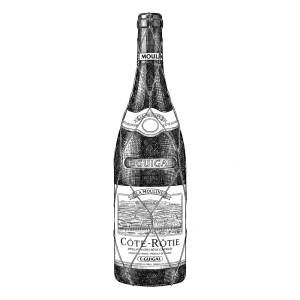
La Mouline
La Mouline is the most aromatic wine in E. Guigal's "La La" trilogy, characterized by a one-hectare vineyard on the Côte Blonde and an unusually generous use of Viognier fermented with syrah. This wine is from the Côte Rôtie, the northernmost cru in the Northern Rhône, where the vines are attached to terraces on the opposite bank of the Rhone River, just south of the town of Vienne.
So what sets La Mouline apart from its better-known siblings, La Landonne and La Turque? In a word: the flavors. Whereas La Landonne is dark and brooding, La Mouline is floral and silky. This is the wine that collectors choose when they want the most seductive flavors, not the intensity of Côte-Rôtie. In 1966, it became one of the first single-vineyard wines bottled in the appellation, putting the appellation back on the world map.
About E.Guigal
Ampuis is a small village on the right bank of the Rhône, and Etienne Guigal turned it into the reference point for Côte-Rôtie. Étienne Guigal started the estate there in 1946 after fifteen years working at Vidal-Fleurie, and the family bought that company outright in 1984 (a neat reversal). Today the estate owns around 45 hectares, roughly half in Côte-Rôtie, the rest spread across Condrieu, Saint-Joseph, Hermitage and Crozes-Hermitage. But Guigal is also the valley's leading merchant, handling about 40 per cent of all Côte-Rôtie and around 45 per cent of Condrieu, with total production near seven million bottles a year. Marcel Guigal runs it with his son Philippe, chief winemaker since 1997. Late harvesting is the house habit. They usually pick among the last in the appellation.
History & Heritage
La Mouline quietly existed for nearly 20 years before the public took notice. This single vineyard wine made its debut in 1966, but it was in the early to mid-1980s that everything changed. Robert Parker tasted Guigal's La Las and endorsed it in print. Côte Rôtie, which had long been in the shadow of Hermitage, was suddenly in demand around the world.
Guigal kept investing, kept buying land (Vidal-Fleury in 1984, the estates of de Vallouit and Jean-Louis Grippat in 2001 and Domaine de Bonserine in 2006) and stuck to a philosophy of long growing. The wines you buy today are more or less same wines as in the 1980s.
Terroir & Climate
La Mouline is situated in the very heart of Côte Blonde, on lighter, paler soils which gave this half of the Côte Rote its name. The bedrock consists of gneiss and granite, covered by a light, silty topsoil and a layer of calcareous loess, a world apart from the iron-rich shale of neighbouring Côte-Brune. The difference is evident in the glass: Côte Blonde offers aroma and silkiness, whilst Côte Brune offers power.
The light, well-drained soil fosters refinement rather than power. Add to this the terraces, winding up the slope in the shape of a Roman amphitheatre and reaching gradients of up to 60°, the warming influence of the River Rhône below, and vines, the oldest of which date back to 1893, their average age is almost a century, and you have one of the most distinctive single-vineyard sites in the Northern Rhône.
Grape Varieties
The blend of La Mouline is as follows:
- 89% Syrah, dark fruit, pepper, structure.
- 11% Viognier, fermented in the same tanks as the Syrah.
This percentage of Viognier is the highest of the three La Las wines (La Landonne is 100% Syrah, La Turque is about 7%). Co-fermentation is very important; this is a true marriage of vineyards, not a later blending. Viognier lifts the flavors into apricot and floral territory and softens the tannins. La Mouline can therefore be drunk more openly at a younger age than its brethren.
Winemaking
The decisive choice for La Mouline is élevage: it is aged in 100% new French oak barrels (small 225-liter Bordeaux-style barrels) for about 42 months. In other words, three and a half years. Most wines would be crushed by that much new oak. La Mouline soaks it up.
Why? Because the concentration of old vines on Côte Blonde and the late vintage ripening time that Guigal adheres to give the wine enough flesh to integrate the oak rather than wear it out. Fermentation is in stainless steel vats, with traditional pump-overs, fermentation and maceration lasting around four weeks. The barrels are made in Guigal's own workshop, which is rare in the wine world.
What are the best vintages of La Mouline
La Mouline is a very consistent scoring wine. Exceptional vintages are (last 4 decades): 1985, 1990, 1991, 1998, 1999, 2003, 2005, 2010, 2018.
Food Pairing
La Mouline's silky smoothness and flavorful lift require dishes that combine richness and finesse. Here are some dishes with which it pairs particularly well:
- Roasted squab or duck breast with cherry or blackberry sauce, where the fruitiness echoes the viognier.
- A simple roasted saddle of venison.
- Lyonnaise beef daube cooked over low heat where the acidity of the wine cuts through the fat.
- Aged Comté, Beaufort and walnut cheeses.
Serve at 16-17°C. If you're feeling extravagant, a classic partner for the wine would be truffle dishes.
Serving Suggestions
La Mouline at 16-17°C. Any warmer and the alcohol will dominate and mask the flavors. Decant young wines for at least 90 minutes and mature bottles (over 15 years old) for 30 minutes. To get a good sense of the aromas, it is better to use a large bowl shaped like a Burgundy glass rather than a Bordeaux glass.
Vintages
La Mouline has remarkable consistency from vintage to vintage, but the style changes: warmer years, such as 2018 and 2019, bring more ripeness, riper Viognier apricots and denser flavors that can be approached earlier; cooler years, such as 2016; and more classic vintages, such as 2012 and 2013, The more classic vintages are more aromatic and structured, with spicier black pepper and firm tannins that require aging.
For medium-term aging, warmer vintages of 12-15 years are suitable. For longer aging, more structured vintages require patience for 20 years or more. Older bottles tend to cost more, which is justified given how slowly this wine unfolds.
E.Guigal
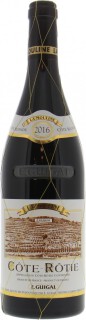
2016
€ 269,00 (ex Vat) € 325,49 (in Vat) more info
E.Guigal
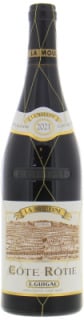
2021
€ 329,00 (ex Vat) € 398,09 (in Vat) more info
E.Guigal
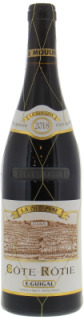
2018
€ 289,00 (ex Vat) € 349,69 (in Vat) more info
E.Guigal
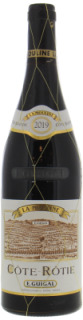
2019
€ 329,00 (ex Vat) € 398,09 (in Vat) more info
Cellaring Potential
Most La Mouline wines take 10 to 15 years to truly sing, and the best ones can last 25 to 30 years if stored well. The driving force behind this wine are firm but fine tannins, healthy acidity and concentration, which are due to old vines and paltry yields per hectare. 12-14°C, stored on its side, away from light. Over time, fruitiness shifts from raspberry to tapenade and forest floor.
FAQ
Is La Mouline 100% Syrah?
No, it is not. It is about 89% Syrah and 11% Viognier fermented together. It has the highest proportion of Viognier of the three Guigal 'La' varieties.
How is La Mouline different from La Landonne?
La Moulaine is an aromatic, silky wine produced on the Côte Blonde. La Landonne is 100% Syrah from Côte Brune, darker and more structured. They are different wines from the same estate.
Is La Mouline an investment wine?
Yes, it is an investment wine. The production volume is small (about 400-500 cases per hectare per year) and the demand is global. The best vintages enjoy a stable reputation.
When is La Moulin safe to drink?
At least 10 years after harvest. The best drinking period is after 12-25 years of aging.
