| Classification | Cru Classe |
| Type | Red |
| Producer | Chimere |
| Vintage | 2010 |
| Country | France |
| Region | Rhone |
| Appellation | Châteauneuf-du-Pape |
| Grape | Rhone Blend |
| Volume | 1,5 |
| Condition | Perfect |
| Label | Perfect |
| Drinkable | -2046 |
| Stock | 1 |
Mourvèdre makes up the majority: 93%, with Grenache at 5% of the blend, the remainder consists of white grape varieties, in Chimère's 2010 Châteauneuf-du-Pape, southern Rhone.
Aging took place in a single 300-liter foudre (a large wooden cask). Manfred Krankl, Pascal and Vincent Maurel and Philippe Cambie were involved in the production of this wine.
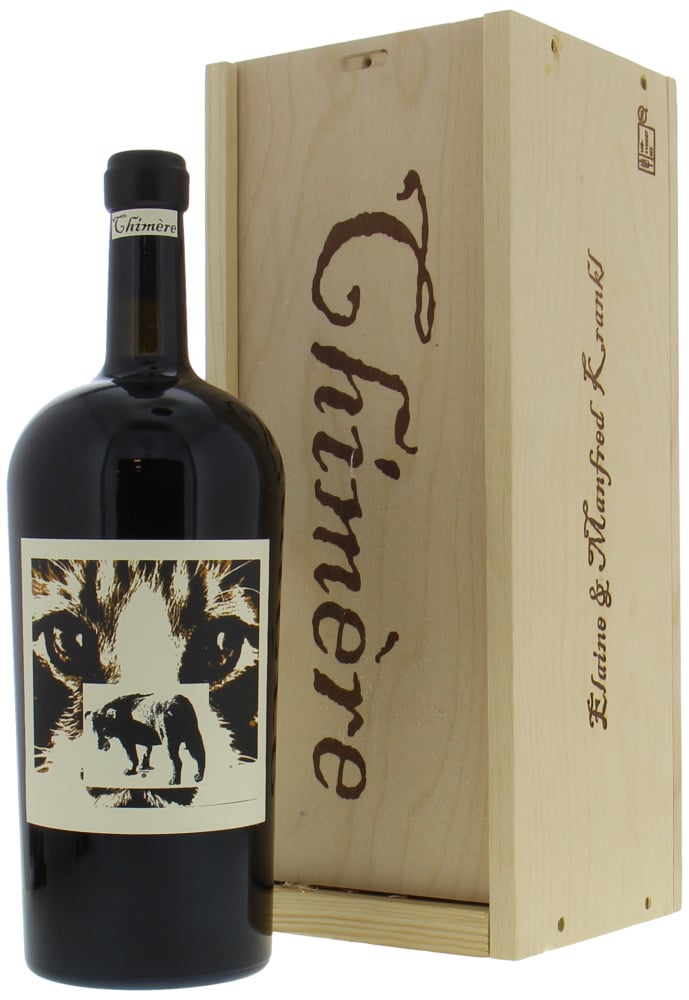
Another amazing offering is the 2010 Chateauneuf du Pape Chimere, a blend of 93% Mourvedre, 5% Grenache and the rest white varietals. Packaged in a distinctive Italian glass bottle, this inky/purple-colored 2010 exhibits notes of blueberries, charcoal, roasted herbs and scorched earth. The complex aromas are followed by a full-bodied, super intense, young, unevolved wine that was bottled April 26, 2012, but still resembles a barrel sample. As the wine sits in the glass, aromas of blueberries, licorice and graphite emerge. While the tannins are sweet, they are abundant. This remarkable effort came from one 300-liter foudre. Forget it for 4-5 years and drink it over the following 3 decades. By the way, it is about 16% natural alcohol so it is actually less powerful than the 2011. Kudos to Manfred Krankl, Pascal and Vincent Maurel, and Philippe Cambie for this remarkable effort.
Initially, it offers aromas of charcoal and toasted herbs, followed by notes of charred earth; its color is similar to ink. Then fruit comes, black fruit, some red fruit. Mourvèdre has given this Châteauneuf-du-Pape its structure. The natural alcohol content is about 16%. It still feels young aeven at this age. It benefits from exposure to air. Beautiful well, very well balanced, elegant, silky.
In this region, where Grenache typically dominates, Mourvèdre holds a leading position. The 2010 Chimere blend consists of:
The 2010 Chimere Chateauneuf du Pape was made for long-term aging, and the tannins and deep concentration of the Mourvèdre add vitality to the wine. For optimal enjoyment, let it breathe in a decanter for 1-2 hours before serving at 16-18°C.
Chimère is not a domaine. No château, no vineyard purchase, no cellar of its own, just three parties who already make wine and decided to make one together: Manfred Krankl of Sine Qua Non in California, the consulting oenologist Philippe Cambie, and the Maurel brothers of Clos Saint Jean in Châteauneuf-du-Pape. Between them they had Châteauneuf-grown grapes and a working winery from the start, which is the practical reason the project happened at all. That is unusual in an appellation where new ventures normally begin with buying land. The output is a single red Châteauneuf-du-Pape, made in small quantities. No second label, no white, no négociant range. And everything else these three produce, in the Rhône and in California, goes out under their own names as separate businesses.
La Crau supplies the majority of Chimere's Châteauneuf-du-Pape. The surface here is covered with Galets roulés, smoothly rounded quartzite pebbles, which absorb the sun's heat during the day and release it at night. That is how Mourvèdre, a late and slow ripener, finishes properly in the southern Rhône. The gravelly soil also enhances tannins and concentration. The Mistral wind, which blows for about 130 days a year, thickens the grape skins and suppresses the occurrence of disease.
Selection is key. Instead of vinifying the entire vineyard's harvest, the Chimere partners select specific Mourvèdre lots to create a single Châteauneuf-du-Pape wine centered on them. With small-batch production, a single label, and no room to hide subpar oak barrels, the result is a wine of exceptional density.
Salt-cured, char-grilled lamb serves as the benchmark for this wine. The fat and protein soften Mourvèdre's tannins.
Intense flavors on the plate are more important than subtlety. This wine makes mild dishes taste bland.
With track & trace code