| Classification | Cru Classe |
| Type | Red |
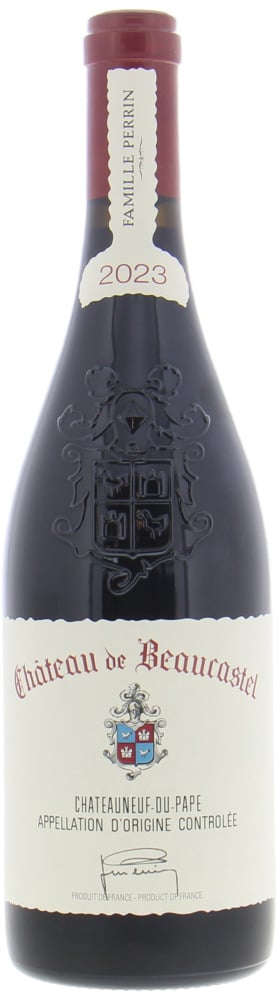
| Producer | Chateau de Beaucastel |
| Vintage | 2023 |
| Country | France |
| Region | Rhone |
| Appellation | Châteauneuf-du-Pape |
| Grape | Rhone Blend |
| Volume | 0,75 |
| Condition | Perfect |
| Label | Perfect |
| Drinkable | 2025-2050 |
| Stock | 15 |
In 2023, the southern Rhône had one of the warmest growing seasons in recent years. At Château de Beaucastel, buds sprouted earlier than usual, leading to intense fruit growth throughout the summer. But the Perrin family took their time. They delayed harvesting more than many neighboring châteaux and waited until full phenolic maturity. Their patience is evident in the 2023 vintage. It is more structured than the immediately appealing 2022, and has the structure to stand up to aging and become the hallmark of a great Châteauneuf-du-Pape.
As usual, the 2023 Chateauneuf du Pape from Château de Beaucastel was matured in foudres. Wafting from the glass with aromas of pepper, garrigue, dark berries and flowers, it’s medium- to full-bodied, round and sappy, with a layered core of fruit and a dense, precise mid-palate framed by velvety tannins, concluding with a firmer, gently spicy finish.
Component parts and their approximate percentages of the final blend follow, though the blend is not yet finalised.
Sample 1: Terret Noir, Muscardin and Vaccarèse (5–10% of the blend)
Supple, rounded and ripe with succulent sweet tannins. Attractive, will give roundness.
Sample 2: Cinsault (5–10% of the blend)
Lovely fine tannins and a waxiness, tight and lovely length.
Sample 3: Counoise (10% of the blend, 50% whole bunch)
Round, supple Counoise is the last grape variety to be harvested – has real poise, elegance and finesse, super-fine tannins.
Sample 4: Grenache (30% of the blend)
Brooding, deep and wild palate with real structure and density. The tannins again are very fine and layered, taut and long finish.
Sample 5: Syrah (5–10% of the blend)
Wild and spiced nose. The palate has notes of baked earth, spice and leather. Something funky here for sure!
Sample 6: Mourvèdre (30% the blend)
Beautiful nose of liquorice and spice with garrigue and wild and spiced notes as well.
Fascinating to taste these component parts and to see what adds to the blend. I expect this to all blend beautifully, with a suppleness and finesse to it. Expect a very, very good Beaucastel from 2023. (AC)
The 2023 Châteauneuf-du-Pape shows well, unwinding with intense blackberry, black cherry and licorice aromatics. Silky and elegant, it hits the full-bodied palate with energy and drive, coming to a close with freshness and focus on the rounded finish. This classy red Châteauneuf can be approached as of 2026.
The estate lost some Grenache due to shatter, so the 2023 Châteauneuf Du Pape is based on 40% Mourvèdre, 30% Grenache, 10% Counoise, 10% Syrah, and the rest a mix of permitted varieties. It was all destemmed except for the Syrah and brought up in foudre. The higher Mourvèdre component gives it a more serious, focused style than most in the vintage, and it has darker blackberry fruits intermixed with roasted herbs, spring flowers, violets, and some meaty nuances on the nose. Medium to full-bodied on the palate, with a deep, pure, layered mouthfeel, it has ripe, velvety, yet building tannins and a great finish. Another beautiful vintage for this cuvée, it has the approachable style of the vintage yet brings more than enough density and concentration to evolve for 30 years. Drink 2025-2054.

Beaucastel's 2023 shows characteristic depth of Mourvèdre, dark plum and blackberry, and distinctive garrigue (bush) notes. The Grenache shows warmth and spice, underlying a wet stone minerality. On the palate, the wine is structured and serious. The tannins are firm but not coarse, and the acidity is sufficient to keep it fresh despite the 14.5% alcohol content. The finish has a sense of herbs and black pepper. This wine is drinkable now, but it has enough staying power to age in the cellar for ten years.
All 13 varieties recognized in Châteauneuf-du-Pape are grown in Beaucastel. Grenache is used extensively in most wine domains, but the main variety here is Mourvèdre, usually about 30% of the blend, with Grenache accounting for 30%. The remaining 40% is Syrah, Cinsault and Cunoise, along with a small amount of other authorized varieties. Why this particular approach? Mourvèdre brings more structure and length. And in a warm year like 2023, its tannin support becomes very important.
Best time to drink: 2026-2038; 2023 has enough concentration and structure for extended aging, but there is no need to wait a decade. Mourvèdre's tannins should soften over the next three years and reveal themselves around 2028. Store in the dark at 12-14°C. Over time, the main fruit flavors will develop into leather, gibier and dried herbs, entering the typical territory of a mature Châteauneuf-du-Pape.
The Perrin family has owned Beaucastel since 1909, but it was Jacques Perrin who shaped the modern look of the estate. His philosophy was simple and straightforward: organic farming (started in 1950, decades before it became fashionable), blending predominantly Mourvèdre and never compromising the character of the wine for the sake of convenience. When he died in 1978, his sons Jean-Pierre and François adopted this approach. Today, the four Perrin brothers manage 130 hectares of land. Best of Wines considers them one of the most consistent producers in Châteauneuf-du-Pape.
The 70-hectare Beaucastel vineyard in Châteauneuf-du-Pape is located in the northeast of the region, near Courzon. The distinctive feature of this site is the galets roulés (large rounded stones that cover most of the vineyard surface). During the day, these stones absorb the heat of the Provencal sun. At night, the accumulated heat is returned to the vines, prolonging the ripening period of the grapes at lower temperatures. Beneath the stones is a Miocene marine molasse covered by alpine alluvium. It is well drained, which is very important in rainy years.
Beaucastel ferments each of the 13 authorized varieties separately in concrete tanks. Before fermentation, the grape skins are briefly heated to 80°C and quickly cooled. This allows the color and aroma to unfold without the harsh tannins often associated with prolonged maceration. Aging takes place in large oak fouders (rather than small barriques), which provide gentle oxygenation without masking the fruity flavors. The result is more terroir and less oak flavor.
The structure and level of spice in this wine demands persistent flavors. Braised shoulder of lamb with rosemary blends beautifully with the fat, which does a great job of softening the tannins. Paired with mature Roquefort and walnuts, the saltiness of the cheese harmonizes with the fruitiness of the wine. Wild boar ragout also pairs well, especially with its herbal complexity; serve at 18°C and decant 30 minutes if drinking young. Delicate dishes can be overpowered.
With track & trace code