
Cabernet Franc
Cabernet Franc is something of a loyal friend among grapes. The distant ancestor of Cabernet Sauvignon that is particularly popular in the Bordeaux, the Loire and since a couple of years also on the rise in Italy. In the Bordeaux it is often used in blends to make wines smooth and round. On the right bank of the Bordeaux, especially in the colder clay soils, it often forms the basis of the final taste of the wine. Chateau Cheval Blanc is a very good example of this. Also several 100% Cabernet Franc are made, the most famous examples are the Clos Rougeard from the Loire, and the Paleo Rosso from Le Macchiole.
Taste
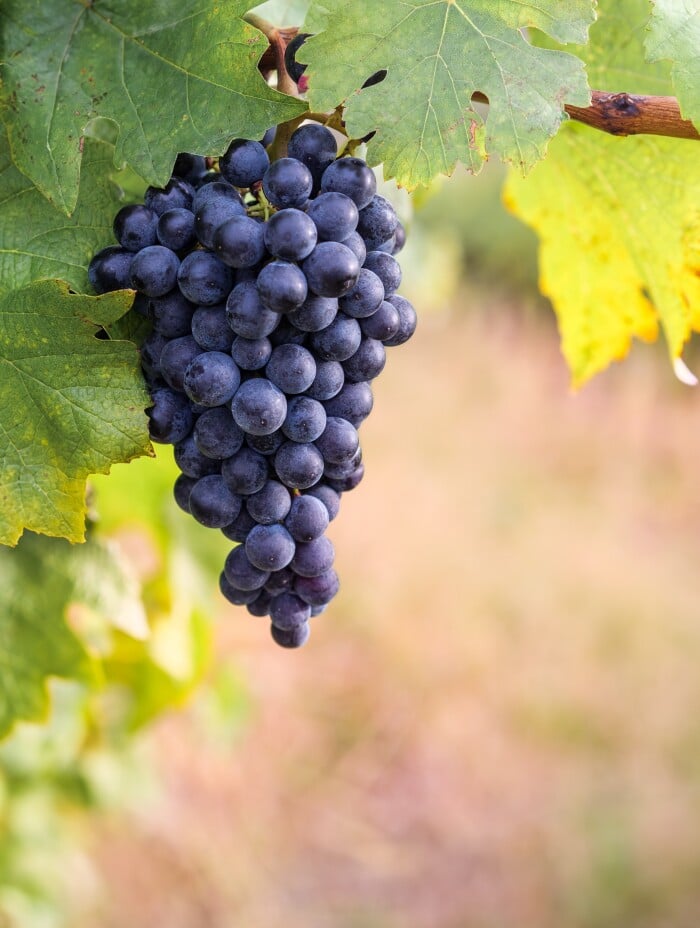
Cabernet Franc is mainly characterized by hints of forest fruits (strawberry and blackcurrant), pepper and pencil shavings. Also, wines from Cabernet Franc can be very perfumed.
Where does the Cabernet Franc grape variety come from?
The exact origin of Cabernet Franc remains unclear. However, the latest genetic research suggests that the grape variety comes from the Basque Country. It is likely to be a cross between the old varieties Morenoa and Hondarribi Beltza, which are almost completely unknown today. The famous Cardinal Richelieu is ultimately responsible for the spread of Cabernet Franc. He brought the first Cabernet Franc vines to the Abbey of Bourgueil in the Loire Valley in the 17th century.
However, Cabernet Franc only really became famous in Bordeaux, where it is an essential component of the blends that traditionally consist of Merlot, Cabernet Sauvignon and Cabernet Franc. The grape variety brings finesse, aromatic complexity and an elegant structure to the cuvée. It perfectly complements the stronger tannins of Cabernet Sauvignon and the fruitiness of Merlot, resulting in harmonious and long-lasting wines.
Cabernet Franc worldwide
Cabernet Franc has spread from France all over the world. In Italy, it is mainly found in the northeast (Friuli and Trentino). Here, too, it is often blended with Merlot. Spain, Hungary and Eastern Europe also have smaller areas under cultivation.
Cabernet Franc has also gained a foothold in the New World, albeit not to the same extent as Cabernet Sauvignon. California is the leading producer in the USA, while countries such as Chile, Argentina, South Africa and Canada also have stocks. A total of 56,000 hectares worldwide are planted with Cabernet Franc. That is quite a respectable figure.
What does Cabernet Franc taste like?
Cabernet Franc is characterised by notes of blackberry, redcurrant and raspberry. However, you can also find notes of green pepper, herbs and violet. Depending on the maturation, spicy nuances such as liquorice or even tobacco can be added.
Cabernet Franc is usually lighter on the palate than Cabernet Sauvignon. The wines have medium tannins, a good acidity and a fresh character. Depending on the vinification, they can range from fruity and fresh to complex and mature. Cabernet Franc is best enjoyed at a drinking temperature of 16 to 18 °C.
What are the ideal growing conditions for Cabernet Franc?
Cabernet Franc is actually one of the few grape varieties that can adapt to almost any climate. However, the grape feels most at home in a temperate climate with moderate temperatures and plenty of sunshine. Because the skin of the Cabernet Franc berry is not quite as thick as that of Cabernet Sauvignon, the grape variety does not need quite as much warmth to ripen reliably. This is precisely why it can also be found in cooler climates, such as those found in Canada. However, it can withstand hot temperatures, which is why it can even be found in Australia.
It is ideal if Cabernet Franc gets plenty of sun and warmth during the day, but then the temperatures drop significantly at night. This causes the berries to ripen more slowly, thus developing more intense aromas. This also helps to preserve the freshness in the grapes. Sunny hillside locations at lofty heights are therefore ideal. Because Cabernet Franc sprouts quite late, late frosts are not usually a problem for the grape variety. It does not cope quite so well with winters that are too cold. Otherwise, the grape is actually robust and therefore uncomplicated to grow.
Incidentally, Cabernet Franc feels most at home on barren soils that are characterised by sand or limestone. This is because these are particularly permeable to water. The grape variety does not like waterlogging as much. Soils of medium texture will also do in a pinch, but then you have to take a little care with Cabernet Franc so that the roots are not too damp in the long term and thus susceptible to vine diseases.
Which wine-growing regions are known for Cabernet Franc?
We have already told you that Cabernet Franc thrives almost anywhere in the world. However, the grape variety reaches its peak in some wine-growing regions. That's why we don't want to withhold these highlights from you.
- Loire Valley, France. The Loire Valley is still the most important area for pure Cabernet Franc wines. The cool climate and the chalky soils promote the freshness and elegance of the wines. The Chinon, Bourgueil, Saumur-Champigny and Saint-Nicolas-de-Bourgueil appellations in particular produce wines with an unmistakable character. Loire Valley Cabernet Francs are often lighter and fruitier, with pronounced acidity. They display aromas of red fruits, herbs and floral notes such as violet.
- Bordeaux, France. In Bordeaux, Cabernet Franc is mostly used as a blending partner in cuvées – particularly on the Right Bank in appellations such as Saint-Émilion or Pomerol. There, Cabernet Franc thrives on clay and limestone soils that enhance its aromas and structure. In Bordeaux, Cabernet Franc brings finesse, aromatic complexity and elegance to the cuvées. It perfectly complements the powerful tannins of Cabernet Sauvignon and the fruitiness of Merlot.
- Friuli-Venezia Giulia, Italy. In northern Italy, Cabernet Franc is often used as a single variety or as part of a blend. The temperate climate and mineral-rich soils suit the grape variety well. Italian Cabernet Franc wines are often spicy, with notes of herbs and red fruits. They are characterised by an elegant structure.
- California, USA. In California, the climate is warm and very sunny, so Cabernet Franc can really come into its own. The Napa Valley in particular produces very full-bodied and intense Cabernet Francs, which shine above all with hints of dark fruits, chocolate and spices.
Which Cabernet Franc wines are famous?
Which Cabernet Franc wines are famous?
Antinori

2013
€ 259,00 € 313,39 (in Vat) more info
Le Macchiole

2020
€ 89,00 (ex Vat) € 107,69 (in Vat) more info
Duemani

2020
€ 19,95 (ex Vat) € 24,14 (in Vat) more info
Chateau Cheval Blanc

2009
€ 995,00 € 1.203,95 (in Vat) more info
What food goes well with Cabernet Franc?
Whether it's a hearty winter dish or a summer barbecue, Cabernet Franc is delicious all year round. And best of all, it goes with an extremely wide range of different dishes. For example, if you are grilling a steak, the fresh fruitiness of Cabernet Franc harmonises very well with the roasted aromas of the meat, which are also subtly underlined by the fine tannins. A mature Cabernet Franc, on the other hand, is an ideal companion to game dishes such as saddle of venison or venison goulash.
But Cabernet Franc also goes very well with stews such as beef bourguignon, oxtail ragout or coq au vin. The wine's fresh acidity cuts through the rich sauces of these dishes, while its complex aromas emphasise the depth of the food. The wine can also be used in the sauce to enhance the harmony. Cabernet Franc is also an excellent accompaniment to vegetable dishes. It highlights the earthy flavours of mushrooms and the sweetness of roasted vegetables.
Three fun facts about Cabernet Franc
- Cabernet Franc is one of the parent vines of some of the most famous grape varieties in the world. It is the parent of Cabernet Sauvignon (created by crossing with Sauvignon Blanc) and Merlot (created by crossing with Magdeleine Noire des Charentes). Carmenère and Gros Verdot are also among its descendants.
- In colder regions, such as Ontario in Canada, Cabernet Franc is also used to make ice wine, which then impresses with intense strawberry aromas.
- The wide distribution and age of Cabernet Franc are reflected in the approximately 80 known synonyms, including ‘Breton’ in the Loire and ‘Bouchet’ in Bordeaux.
