

Galatrona
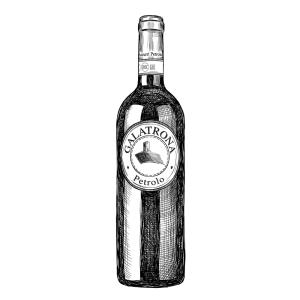
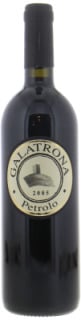
Petrolo’s “Galatrona” wine came about almost by accident. In 1994, due to a delay in the harvest, Luca Sanjust decided to produce a separate wine from Merlot grapes harvested from a vineyard planted just four years earlier. The result was so magnificent that it deserved serious attention. Today, “Galatrona” is one of the most talked-about Merlot wines in Italy, often mentioned in the same breath as famous wines from Pomerol.
Its region of origin is Valdarno di Sopra. This is a small Tuscan region with a protected designation of origin, quietly situated between Florence, Arezzo, and Siena; before “Petrolo” put this area on the world map, virtually no one outside Italy had heard of it. And it is precisely this obscurity that is part of its story. “Galatrona” did not simply follow in the footsteps of Chianti Classico or Bolgheri. It forged its own reputation, emerging from that corner of Tuscany that had remained unnoticed for decades.
About Petrolo
At the helm of “Petrolo” is Luca Sanjust, who entered the world of wine after a career as an artist. In the early 1980s, he attracted attention as one of Italy’s most promising young artists, but later returned to his homeland to take the helm of the family winery. The Bazzocchi family has owned this land since the 1940s, and Luca is the grandson of Gastone Bazzocchi. In 1990, Luca planted his first Merlot vineyard, which became the source of today’s “Galatrona.”
In our view, what sets “Petrolo” apart is its commitment to experimenting with each individual barrel. For “Galatrona,” French barriques are used; for “Torrione,” traditional large “botti” barrels, and for “Boggina A”, terracotta amphorae, a tribute to the Etruscans who once farmed in this valley.
History & Heritage
The lands around Petrolo have been recognized as a region producing high-quality wines since 1716, when Cosimo III de’ Medici included Val d’Arno di Sopra among just four areas in Tuscany producing wines and olive oil of the highest quality. In 1834, agronomist Giorgio Perrin selected a plot on this estate, now known as “Boggina”, as land ideally suited for growing Sangiovese.
However, Galatrona’s own history is not that long. The first Merlot vines were planted in 1990, and the first bottle of wine was released in 1994. Three centuries of agricultural history, four years of viticulture, and a wine that almost immediately attracted international attention—this is a rare combination.
Terroir & Climate
Petrolo is located on the southeastern edge of Chianti Classico, and the vineyards stretch across the hills at an elevation of 250 to 500 meters above sea level. The soil is a mixture of marl, sandstone, and shale; it is loose enough to ensure good drainage and rich in minerals, providing sufficient nutrients for the vines even during dry summers.
The elevation is important because nighttime temperatures remain low, which slows down ripening and preserves the grapes’ acidity. In addition, the surrounding forests further lower the temperature. For the Merlot variety, which often develops a cloying sweetness and loses its firmness when exposed to heat, these are truly ideal conditions. The result is a Tuscan Merlot distinguished not only by its power but also by its freshness and firmness.
Grape Varieties
The blend here is simple:
100% Merlot from a vineyard planted in 1990
Neither Sangiovese, nor Cabernet, nor any other varieties are used in the blend. Only Merlot from a single vineyard on the estate. And this is done intentionally. Petrolo wanted to test the potential of Merlot in this corner of Tuscany, where “Super Tuscan” blends sometimes lack the structural backbone typically provided by Cabernet. Cool nights and mineral-rich soil give this variety the acidity and firmness that wines from warmer regions of Italy typically lack. It is precisely this combination that leads people to compare it to wines from Pomerol.
Winemaking
Yields are strictly limited to 20–25 hectoliters per hectare, which is roughly half the production volume of most Tuscan wineries. The grapes are grown according to the principles of organic farming. Neither irrigation nor plowing is practiced, and the entire area is covered with natural grass. The combination of these stress factors and cool nights gives “Galatrona” its richness without any notes of burnt fruit.
In the cellar, the Merlot is aged in French oak barriques. “Petrolo” does not disclose data on the use of new barrels by year; however, their style places greater emphasis on harmony with the wine than on vanilla aromas. The oak notes are sufficient to give the wine structure, but not so strong as to overpower the fruit notes. This is precisely the winemakers’ pursuit of balance, and this is why this wine is ideally suited for long-term aging.
Food Pairing
This wine’s tannins and acidity call for pairing with fats and proteins. Here are a few dishes that pair well with it:
- Bistecca alla Fiorentina: a classic Tuscan dish—a bone-in steak. It is cooked rare and lightly sprinkled with salt
- Wild boar meat, slow-cooked with juniper: a classic Tuscan dish
- Duck breast with cherry or fig sauce
- Aged Pecorino Toscano. A hard cheese with a pronounced salty flavor that rivals wine in richness
Serve at 16–18 °C. Avoid dishes that are too spicy or too sweet, as they disrupt the balance.
Vintages
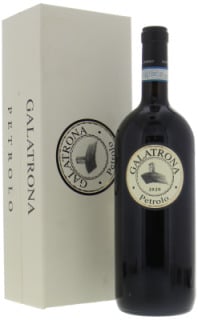
Galatrona exhibits relatively little variation in quality from vintage to vintage, as the cool nights temper the summer heat. Nevertheless, the vintage still plays an important role. In warm years, such as 2020, the wine takes on a richer and more vibrant style, characterized by dark fruit aromas and soft tannins. In cooler, more classic vintages, such as 2021, the wine features a firm palate with pronounced umami, while nuances of graphite and herbs come to the fore. Both styles are suitable for aging, though wines from cooler years often require additional years of cellar aging to fully realize their potential.
Older vintages, such as 2005, are now at their peak of maturity, and you can detect the truffle and leather notes characteristic of aged Galatrona. If you’d like to enjoy the wine sooner, opt for later, warmer vintages.
The best vintages of Galatrona
The level and quality of this wine is very high, regardless of vintage, However, some exceptional vintages are: 2001, 2004, 2009, 2013, 2016, 2018, 2019, 2020, 2021.
Cellaring Potential
Galatrona has a robust structure, rich tannins, pronounced acidity, concentrated fruit flavors, and a framework of French oak. It possesses all the necessary elements for long-term aging. Store the wine in a cellar at a stable temperature of 12–14 °C and with proper humidity. Over time, the initial aromas of black berries become less pronounced, and notes of truffle, leather, and dried herbs come to the fore, creating a fragrant, earthy bouquet. It is then that “Galatrona” will reach its peak.
Serving Suggestions
Serve at a temperature of 18 °C. This is a temperature that is lower than in a typical living room but higher than in a wine cellar. Young vintages should be decanted for at least an hour to allow them to breathe. Merlot needs exposure to air to fully develop its character. For wines from the 2005 vintage and later, 30 minutes is sufficient. It’s best to use large Bordeaux glasses. This wine has enough structure to fully fill the glass. Open the bottle as soon as your guests arrive, before they sit down at the table.
