
Cervaro della Sala
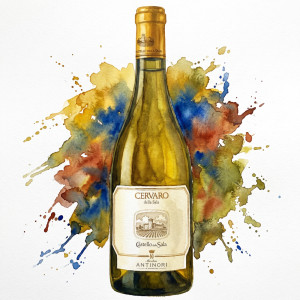
Cervaro della Sala is a wine that proves that Italian chardonnay can compete with Burgundy. Produced by Antinori at Castello della Sala in Umbria, this wine has the discreet Umbria IGT label.
So what's the story behind this wine: the Antinori family from Tuscany, with a six-century history of winemaking, decided to plant Chardonnay on the calcareous clay soils of inland Umbria. They then added Grechetto, a local white grape. The result became one of the benchmarks for true white wine in Italy. And it still is.
About Antinori
Marchesi Antinori dates its wine business to 1385, when Giovanni di Piero Antinori joined the Arte Fiorentina dei Vinattieri, the Florentine winemakers' guild. The family goes back further still: a Rinuccio di Antinoro is recorded making wine at the Castello di Combiate, north of Florence, around 1180. The castle was destroyed in 1202, the family moved into Florence, and for a while wine gave way to silk and banking
For centuries it stayed a sideline next to silk, wool and banking. Then came Piero Antinori, the 26th generation, who broke the Chianti Classico rulebook with oenologist Giacomo Tachis. Cabernet Sauvignon and Cabernet Franc planted in Val di Pesa, aged in barrique, sold as simple table wine because the rules left no other option. That was Tignanello, released in 1974, followed by Solaia in 1978 and Guado Al Tasso from Bolgheri in 1990. The headquarters sit at Bargino, about 30 kilometres south of Florence, between Florence and Siena. Classic Chianti and Super Tuscans, both from the same house.
History & Heritage
Castello della Sala is a castle built in 1350. Antinori acquired the castle in 1940, but it is interesting to note that the first vintage of Cervaro della Sala dates back to 1985. At that time, authentic Italian chardonnay was virtually non-existent as a category. Around the same time, the Gaia & Rey wine from Gaja appeared. These two wines proved that Italy could produce oak-aged Chardonnay at a high level.
What does this story mean for consumers today? The Cervaro experience spans nearly 40 years. The style has been refined but not reinvented.
Terroir & Climate
Castello della Sala is located in Ficulle, in the province of Terni, where the vineyards extend from 220 to 470 meters above sea level. The soils here are calcareous and clayey, rich in Pliocene marine fossils. The combination of limestone-rich soil and real altitude is exactly what Chardonnay needs.
Why it's important. Because Umbria is hot. Without altitude, the wine would turn into a sun-baked, flabby white wine. Diurnal fluctuations (the gap between warm days and cool nights) maintain acidity. The fossil content lends a salinity and minerality that sets Cervaro apart from typical warm-climate Chardonnays. Cervaro is closest to Burgundy in central Italy.
Grape Varieties
The blend is approximately:
- 90% Chardonnay
- 10% Grechetto
Why Grechetto? This white grape hails from Umbria, that 10% is what makes Cervaro more than just an international Chardonnay. Grechetto imparts an herbal, slightly nutty flavor and a textural firmness that pure Chardonnay doesn't have. It anchors the wine in its place. Without Grechetto, the wine could be anywhere. With Grechetto, it is unmistakably an Umbrian wine.
Winemaking
Cervaro's decisive choice is fermentation in French oak barriques rather than steel. Malolactic fermentation also takes place in barrels. This is a Burgundian method that gives the wine a creamy texture and unites it with the oak.
Aging takes place in a mixture of new and used French oak barriques for about six months, after which the wine is aged in bottles before release. By Burgundian standards, six months is modest. It's done intentionally. Cotarella wants the fruit and Grechetto elements to remain audible without drowning in toast and vanilla.
Tasting Notes
The first impression is textural. The Cervaro della Sala has a creaminess due to barrel fermentation and malolactic, but it's wrapped in a bright acid spine that makes everything move. On the nose, ripe yellow apple, white peach, notes of citrus and some toasted hazelnut from the oak. In warmer years, honeysuckle.
On the palate, stone fruit and salty mineral notes due to the rich fossil soil carry over into nutty flavors and faint herbal notes on the finish. The wine is delightful immediately upon release, but it becomes more dense when aged in bottle for five to ten years. A serious white wine that doesn't shout for attention.
Food Pairing
Cervaro has the body to handle rich foods and the acidity to cut through fat. Foods it pairs well with:
- Strangozzi pasta with black truffles from Norcia.
- Roasted capon or chicken in a cream sauce.
- Perch from Lake Trasimeno, simply fried in butter.
- Aged pecorino, especially with acacia honey.
Serve the wine at a temperature between 10 and 12 degrees Celsius. If served too cold, the characteristic texture of the wine will be halved.
Serving Suggestions
Cervaro della Sala should be served at 10 to 12°C. Chilling it in the refrigerator (6-8°C) will cause the aromas to disappear and the texture to smooth out. For young bottles, decanting for 30 minutes will reveal aromas; for older vintages 8 years old or more, use a large Burgundy-style glass to reveal secondary aromas.
Vintages
Although the Cervaro della Sala vineyard is fairly stable, vintage is more important for white wines than is commonly believed. Warmer years in Umbria lead to riper stone fruits, fuller body and more pronounced oak notes in young wines. Cooler years lead to a denser, more citrusy cervaro that takes longer to ripen but does so with real precision.
If you're drinking it now, look for vintages with 5-8 years of aging. These are the ones that show toasty, nutty secondary notes. If you want to age it in the cellar, look for cooler, more structured vintages. Cervaro is one of the few Italian white wines worth aging for 10 years or more.
Antinori
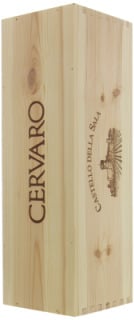
2022
(Magnum) € 164,00 € 198,44 (in Vat) more info
Antinori
2024
€ 69,95 (ex Vat) € 84,64 (in Vat) more info
Antinori
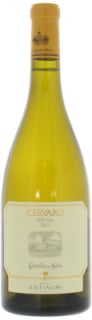
2023
€ 69,95 (ex Vat) € 84,64 (in Vat) more info
Antinori
2023
(Magnum) € 159,00 € 192,39 (in Vat) more info
Cellaring Potential
Most Cervaro vintages can be drunk up to about 12-15 years after release. It is based on acidity (high due to altitude), texture from lees aging, and the mineral charge provided by calcareous soils. It is stored at a stable temperature of 12-14°C. With time, the primary fruit flavors recede and the honey, hazelnuts and beeswax become more perceptible. This is the essence of Cervaro.
