

Caberlot
Caberlot is the world's only Caberlot wine, as the name suggests. It is a natural hybrid of Cabernet Franc and Merlot, discovered in the 1960s in an abandoned vineyard near Verona and bred in only one place: the Podere Il Carnasciale on the Valdarno hill in Tuscany. In other words, this is not a super Tuscan wine in the sense of Sassicaia or Ornellaia. It is completely unique.
The wine, which tastes nothing like either Cabernet Franc or Merlot but borrows traits from both, is classified as IGT Toscana, is made in small quantities and is only available in magnums and double magnums. Best of Wines considers this wine to be one of the most truly original wines released in Italy.
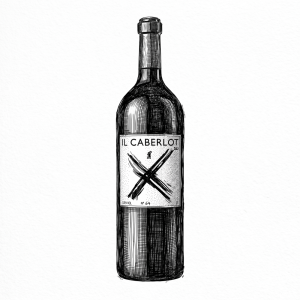
About Il Carnasciale
Il Carnasciale is the only winery in the world that works with Caberlot grapes. This alone sets it apart from others. The winery was founded in the 1980s by Wolf and Bettina Rogosky, who were friends with agronomist Remigio Bordini. Bordini found the original mother vines and gave them exclusive rights to propagate them.
Today, Bettina runs the farm with her son Moritz, while longtime consultant Peter Schilling manages the winemaking manages the winemaking. The farm's philosophy is simple: low yields, dense plantings and fanatical attention to detail. We keep wines from this estate because no one else can make wine like this. There is no substitute for it.
History & Heritage
The story began with a discovery. Bordini found a handful of vines near Verona of an unknown variety that looked like a natural cross between Cabernet Franc and Merlot. He named it Caberlot. The first commercial vintage of Il Carnasciale was released in 1988.
Why is it important today? Because cult status came almost immediately, and the estate didn't expand to match it. Production remained tiny and the "magnum only" format took hold, with a second wine (simply called Carnasciale) added in 2000. All bottles have handwritten serial numbers. The cross on the label is hand drawn.
Terroir & Climate
The estate is located in Mercatale Valdarno, between Florence and Arezzo, at an altitude of about 300 meters. The soil is a mixture of clay, sand and galestro (shale marl found deep in Tuscany). It is stony, well drained and not particularly fertile. Precisely as desired.
Why does altitude matter? Because the cool nights coming down from the hills of Pratomagno delay the ripening of the grapes and preserve their acidity, which is easily reduced by the hot Tuscan summer. Incidentally, the Valdarno di Sopra area is one of the oldest winemaking areas in Tuscany, dating back to Cosimo III's decree in 1716. Petrolo, just a stone's throw away, is the closest neighbor with similar qualities.
Winemaking
The format is as in the title. Caberlot is bottled only in 1.5-liter magnums and 3-liter double magnums; there are no 750-milliliter bottles. The reason is that larger bottles age more slowly and gracefully, and the Rogoskys want the wine to live a long life.
The plots are vinified separately in stainless steel. After fermentation, the wine is aged in 100% new French oak barriques (standard 225-liter barrels from Bordeaux) for about 24 months. Blind tastings are then conducted. Only the best batches are bottled as Caberlot. All others become second wines. This selection is what makes the wines so consistent, and production is limited to about 2,500-3,500 magnums per year.
Tasting Notes
The first impression is aromatic lift. The aroma of Cabernet Franc has a graphite-like foliage feel, with a dark, full weight of Merlot underneath. Spicy aromas of black cherry, violet, tobacco and iron. New oak is well integrated, though there are touches of cedar and sweet spice.
In the mouth, the tannins are firm but refined. There is neither the bulky structure of a Bordeaux cabernet nor the soft smoothness of a pure merlot. In between lies freshness. Concentration without heaviness. Most vintages drink well from the fifth year onwards and age slowly thanks to the magnum format. Patient lovers will be rewarded.
Food Pairing
Caberlot has just the right structure for authentic Tuscan cuisine. Some suggestions:
- Bistecca alla Fiorentina, simply grilled. The fat of the beef softens the tannins and the wine cuts through the charring.
- Peposo, a Tuscan-style beef stew slow-cooked in black pepper and red wine. Cooked especially for this.
- Wild boar stew on pappardelle. The flavor of the wild boar combines with the spiciness of the wine.
- Pecorino Toscano Stagionato (aged sheep's milk cheese) with chestnut honey.
At 16-18°C.
Serving Suggestions
Serve at 16-18°C. In many home environments, room temperature is too warm and mutes the flavors. Decant young wines for at least 90 minutes and wines over 10 years old for 45 minutes. A large Bordeaux glass works well. Magnum format wines will change considerably after opening. Plan accordingly.
Vintages
Through blind tastings, Caberlot is remarkably consistent, but vintage characteristics do emerge: warmer years such as 2019 bring more fruit, more mature tannins and earlier availability. Cooler, more classic vintages tend to be denser in youth and take more time to develop. We consider 2004, 2006, 2010, 2015, 2016 and 2019 outstanding.
For medium-term drinking, the late 2010s vintages are good; 2018 was a bit cooler and has a spicier, more structured profile, while 2019 tends to be richer and more generous. For long-term aging, any of the best estate vintages require patience for 15 years or more.
Il Carnasciale
2017
(Magnum) € 205,00 € 248,05 (in Vat) more info
Il Carnasciale
2019
(Magnum) € 255,00 (ex Vat) € 308,55 (in Vat) more info
Il Carnasciale
2018
(Magnum) € 245,00 € 296,45 (in Vat) more info
Il Carnasciale
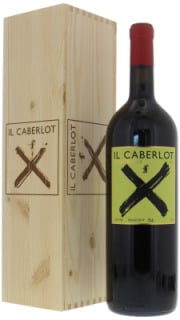
2018
(Magnum - in single OWC) € 255,00 (ex Vat) € 308,55 (in Vat) more info
Cellaring Potential
A good magnum of Caberlot is capable of aging for 20-25 years from harvest, and even longer for the best vintages. The driving force behind this is the firm tannin structure, fresh acidity due to altitude and slow oxygen exchange in large magnums stored at 12-14°C and stable humidity. The young crop reaches its peak from the eighth year onwards. Expect the fruit to deepen, the oak to integrate and tertiary savory notes (leather, tobacco, dry herbs) to emerge.
