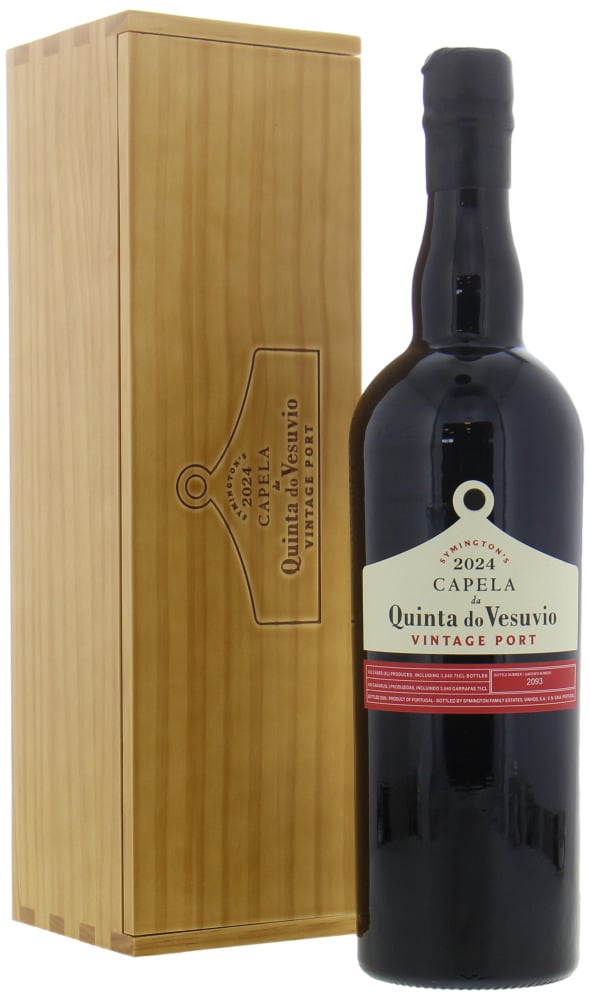
Capela Vintage Port 2024 is een veldmix van druiven afkomstig van meer dan 100 jaar oude wijnstokken op het Douro-landgoed Quinta do Vesúvio, in het noorden van Portugal, en bevat ook druiven van andere percelen, waaronder Touriga Franca. In totaal werden er slechts 5.160 flessen geproduceerd.
De groeiomstandigheden in 2024 waren mild en het fruit rijpte geleidelijk. De dagtemperaturen bleven tussen de lage en midden 30s C, terwijl de nachttemperaturen tijdens de oogstperiode aanzienlijk daalden. Dit verklaart het aroma van deze wijn: een verfrissend bouquet waarin donkere bessen, lavendel, kruiden en dennenhout samenkomen. De wijn is vol van smaak met een stevige structuur; de droge en ingetogen smaken zorgen voor een goede balans met de zoetheid, met korrelige tannines en een scherpe maar lang aanhoudende afdronk in de mond.
Capela ondergaat een langere gistingsperiode dan de Quinta do Vesúvio-wijn van het landgoed, gevolgd door 18 maanden rijping in eikenhouten vaten. Een deel van de Touriga Franca wordt geproduceerd uit de wijngaard Vale da Teja, waar de wijnstokken meer dan 50 jaar oud zijn.
Deze wijn komt het best tot zijn recht tussen 2038 en 2078. Het is gebruikelijk om jonge Vintage Port te decanteren; deze wijn heeft een robuuste structuur waardoor het de moeite waard is om erop te wachten.
Robert Parker (97)
The 2024 Capela da Quinta do Vesúvio Vintage Port, named after the Chapel Vineyard, which is the first to be replanted after phylloxera, is a field blend of centenary vines, and the wine also has grapes from other plots, including a younger one planted exclusively with Touriga Franca. It fermented with indigenous yeasts in stone lagars that were foot trodden and then matured in oak casks for 18 months. This somehow didn't have the energy and edge of the regular Vesúvio. It has notes of orange blossom, a hint of resin and rockrose, and it grew in the glass. It has lavender, notes of pine needles, the Vesúvio signature, and is explosive in the mouth, with well-armed tannins. It's a big wine but has balance. It has 20% alcohol, a pH of 3.65 and 101 grams of sugar. 5,160 bottles produced. It was bottled in 2026.
James Suckling (96)
Graphite and blackberries, very aromatic and absorbing. Full-bodied and chiselled, with an engaging austerity that complements a sense of restrained sweetness. Grainy and sharp on the finish. Vines from Vinha da Capela co-fermented with alicante bouschet from Vinha dos Castelos; touriga nacional from Vinha da Escola co-fermented with sousão from Vale da Teja and touriga franca (50+ years) from Vale da Teja.
Jancis Robinson (19)
Only the sixth vintage in almost 20 years. Vinha da Capela field blend/old vines plus Vinha dos Castelos Alicante Bouschet (co-fermentation); Vinha da Escola Touriga Nacional plus Vale da Teja Sousão (co-fermentation); Vale da Teja Touriga Franca (50+ years). This has a longer fermentation than the Quinta do Vesúvio and a drier profile. TA 4.6 g/l, RS 101 g/l. Bottled May 2026 without filtration. 430 cases, ie 1% of the vineyard’s production in 2024.
Black core. Extremely intense aroma of black fruit with a hint of lavender and a herbal impression. Drier than Vesúvio. A big punch of compact tannins and yet remarkably silky. Slides across the palate like a heavyweight boxer floats across the ring. Deep and rich and yet lifted by that herbal freshness. A powerful beauty that finishes dry. Julia Harding MW
Vinous (96)
The 2024 Capela da Quinta do Vesuvio Vintage Port is the sixth time this cuvée has been released, a selection of parcels populated by century-old vines at the namesake quinta. It has a perfumed nose that is more floral than Vesuvio's regular bottling, more open, with scents of black plum, bay leaf and, again, that touch of Japanese nori. The palate is silky smooth on the entry with impressive depth. Plush and saturated tannins, very well judged acidity, there is impressive weight on the finish with a liberal sprinkling of black pepper. Quite a forthright Vintage Port, give this a few years in the cellar.