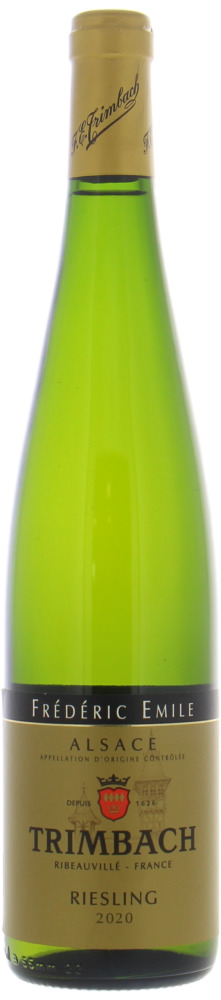
Ce lot est issu de vignobles situés sur des coteaux. Un tiers provient du Geisberg et deux tiers de l'Osterberg. Il s'agit du millésime 2020 du Riesling Cuvée Frédéric Emile.
Riesling Cuvée Frédéric Émile de Trimbach, en Alsace. L’âge des vignes varie entre 40 et 80 ans. Elles poussent sur des strates complexes : calcaire, calcaire coquillier (Muschelkalk), marne, grès (des Vosges) et migmatite (gneiss et granit).
2020 a été une année chaude et sèche. Alors que Colmar a enregistré 424 mm de précipitations, la Lorraine en a enregistré 758 mm et la moyenne nationale s’est élevée à 778 mm ; ces caractéristiques climatiques se reflètent dans le vin.
Anne-Catherine est la maître de chai ; la cave abrite de vieux fûts et des cuves en acier inoxydable. Après le foulage, les raisins blancs sont pressés délicatement à l’aide de quatre presses pneumatiques.
Il est recommandé de décanter ce vin au moins une heure avant de le servir. Ce vin se dégustera idéalement entre 2026 et 2044.
Robert Parker (92)
The 2020 Riesling Frédéric Emile has blended the fruit of the Geisberg (one-third) and Osterberg (two-thirds) for decades. The wine opens with a fine and flinty, deep and elegant nose that is beautifully pure and stony. Succulent and supple on the palate, with savory acidity and still-grippy tannins, this is a powerful Riesling with ripe and sweet fruit (4.6 grams per liter) carried by fine-grained acidity, and it has a still-astringent finish. Luckily, this still-embryonic wine won't be released before 2026 or even 2027. 13.7% stated alcohol. Tasted at the domaine in May 2022.
James Suckling (96)
Shy, cool and tightly wound on the nose, the aromas of stone fruit, citrus and fresh nuts opening slowly as it aerates in the glass. Very impressive structure on the straight and linear palate, the fruit expanding again at the long, concentrated finish. From 40 to 80-year-old vines in the Grand Cru sites Kirchberg and Osterberg. Long-term stuff!
Vinous (96)
The 2020 Riesling Frédéric Emile is from the Geisberg and Osterberg Grand Crus and, exceptionally, also the Kirchberg. It opens with chamomile and dried yarrow, showcasing a very subtle but aromatic nose. It is on the palate that the beautiful aromatics come through, almost with a floral quality of hawthorn blossom. There is a chalkiness in the texture, a lovely depth and verticality. This is serenity itself: the year may have been hot, but this has kept its cool. It shrugs off any hint of heat and presents us with its essential nature. Long and indestructible. Wow. (Bone-dry)