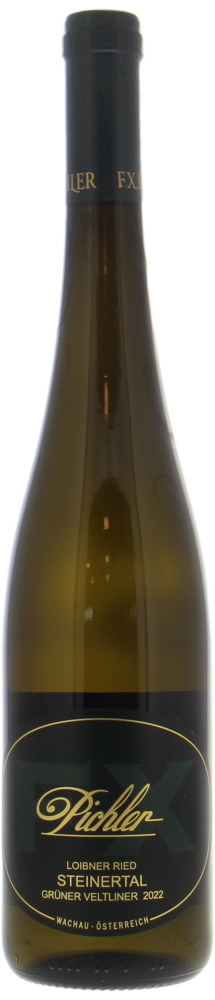
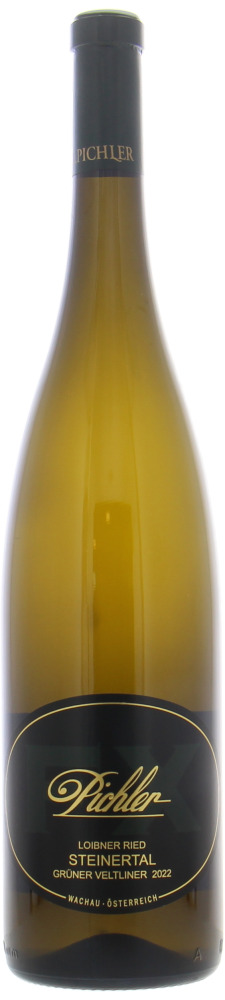
Ried Steinertal ist eine der Einzelweinberge von F.X. Pichler in der Wachau, aus denen der trockene Grüner Veltliner Smaragd gekeltert wird; der Jahrgang 2022 wurde aus Trauben gekeltert, die auf tieferem Mutterboden auf verwittertem Gneis wuchsen. In der Nase entfalten sich Aromen von frischen Kräutern und Farnen, während am Gaumen der klare, mittelkräftige Geschmack eine mineralische Note und einen salzigen Abgang hinterlässt. Er wirkt eher geschmeidig und fest als schwer. Der Abgang ist trocken, raffiniert und außergewöhnlich lang.
Die Vegetationsperiode 2022 war von kühlem, regnerischem Wetter und einer verlängerten Blütezeit im Juni geprägt. Auch zu Beginn der Ernte, die Mitte September einsetzte, regnete es, und während der Sortierung im Weinberg gingen im Vergleich zum langjährigen Durchschnitt etwa 15 % des Gesamtertrags verloren. Für diesen Wein wurden ausschließlich die verbleibenden Trauben ausgewählt.
Alle Grüner Veltliner-Trauben werden hier entrappt und in Edelstahltanks vergoren. Der Einzellagenwein reift anschließend 6 bis 8 Monate auf der Feinhefe in großen, gebrauchten Eichenfässern, was ihm Textur verleiht, ohne Eichenaromen zu übertragen.
Lucas Pichler (7. Generation) ist seit 2000 alleiniger Winzer bei F.X. Pichler, das 1971 den Namen F.X. Pichler annahm. Die Trauben stammen aus biologischem Anbau, und dieser Wein ist vegan. Das Weingut bezieht seine Trauben aus dem eigenen 18,5 Hektar großen Weinberg sowie aus weiteren 1,5 Hektar.
Am besten zwischen 2024 und 2044 genießen.
James Suckling (97)
Incredible herbal freshness in the nose with notes ranging from sage to tarragon plus a hint of ferns and moss after rain. Extraordinary precision and purity on the medium-bodied palate. Great wet stone purity and racy tension at the super-long finish that must be experienced to be believed. It’s miraculous that a gruner veltliner with just 12.5% alcohol can have this concentration and brilliance. From organically grown grapes. Vegan.
Vinous (95)
The 2022 Grüner Veltliner Steinertal is from Pichler's coolest site, on terraces with deeper top-soils above weathered gneiss—thus with more water-holding capacity. As the Steinertal is a gully, cool winds sweep down at night and provide diurnal range. The nose is alive with herbal savoriness, referencing chervil, crushed yarrow and fern. The palate carries these herbal notions and adds both ripe pear tones and slight saltiness on a textured, yeasty, distinctly peppery body. This is beautifully clear, clean-cut and svelte, with a lovely boost of pepper on the finish. (Bone-dry)
Lucas Pichler is the seventh generation of his family to head this estate, which was named F.X. Pichler in 1971 when his father, Franz Xaver Pichler, took over. Lucas Pichler joined his parental estate in 1998, after finishing viticultural college in Krems and training with Müller-Catoir in the Pfalz and Manfred Tement in Styria. He worked alongside his father until 2000, when he became sole cellarmaster. He began farming organically in 2016; the conversion to organic certification started in 2020 and the estate has been certified organic since 2023. Pichler farms 18.5 hectares and buys fruit from another 1.5 hectares, also certified organic. The varietal split is 60% Grüner Veltliner and 40% Riesling, with just a little Gelber Muskateller in two parcels in the Loibenberg—which is now mainly made into grape juice and marketed to top restaurants. Until 2019, there was also Sauvignon Blanc, but that’s now discontinued. All Grüner Veltliner is destemmed and fermented in stainless steel. The village wines stay in stainless steel, while the single-site wines are aged on fine lees in large used barrel for six to eight months. Riesling is mostly whole-bunch-pressed after slight crushing and followed by three to six hours of skin contact, depending on site and vintage. No sulfur dioxide is added before fermentation, and botrytis is absolutely avoided. The only wine, both fermented and aged in wood, is the Grüner Veltliner Unendlichbut. Pichler provides a useful shorthand: all screw-capped wines are made in stainless steel only, and the wines that saw wood have cork closures. The “Monumental” or “M” wines are no longer produced, as they were, according to Pichler, “no longer in keeping with the style” –which is crystalline, linear, taut, and focused on translucency, drive, and elegance. The Unendlich wines are only made in the ripest years. Pichler looks for site expression and the maximum of varietal expression in a dry wine.
Pichler notes that rain in the early stages of the 2022 harvest, which started in mid-September, was “challenging.” Sorting was crucial and resulted in about 15% loss of fruit compared to the long-term average. During my visit, I tasted the 2022 Rieslings and Grüner Veltliners, plus the 2021 vintages of each variety’s Unendlich bottling. No Unendlich was made in 2022.
BOW (9-)