| Classification | None |
| Type | Sparkling |
| Producer | Dom Perignon |
| Vintage | 2015 |
| Country | France |
| Region | Champagne |
| Grape | Pinot Noir, Pinot Meunier, Chardonnay |
| Alcohol % | 12.5% |
| Volume | 0,75 |
| Condition | Perfect |
| Label | Perfect |
| Drinkable | 2024-2054 |
| Stock | 5 |
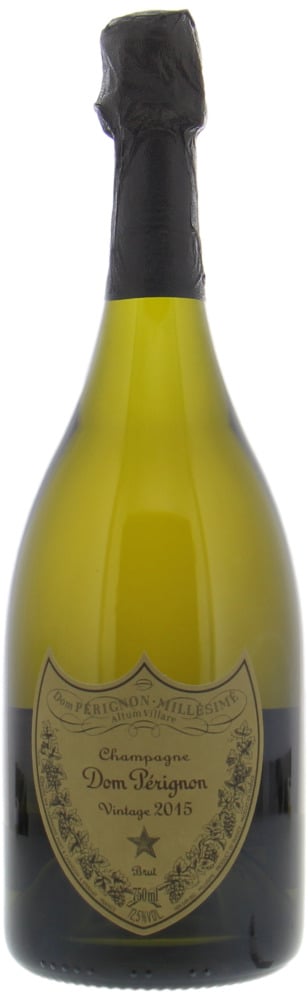
The 2015 harvest was an exceptional growing season in Champagne, characterized by warm and dry conditions that guaranteed optimal ripening. For Dom Perignon 2015, these favorable conditions produced grapes with concentrated flavors and excellent balance. The harvest took place under perfect weather conditions, resulting in a Champagne that combines power and elegance. Vincent Chaperon crafted this vintage to reflect the distinctive character of 2015.
Disgorged in January 2023, the 2015 Dom Pérignon shows a singular, ethereal profile with aromas of white pepper, iodine, ripe orchard fruits, toast, smoke, herbs and spices. Medium to full-bodied, layered, and structured, it’s enveloping and round with a delicate phenolic mid-palate that underlines chalky dry extracts, concluding with a sapid, penetrating finish with gastronomic bitterness. This iteration of Dom Pérignon, though replete with the customary charm and vinous generosity that typify the label, distinguishes itself by its structural delicate austerity and a notably phenolic profile, giving rise to a remarkably linear and well-defined style that diverges markedly from the more familiar expressions of Dom Pérignon. This is a blend of 51% Pinot Noir and 49% Chardonnay with a dosage of 4.5 grams per liter; it will age wonderfully and can be enjoyed now or over the next 20 years.
Pale honey colour and some notes of green leafiness. Still very tight and tense, as though it still has to relax and breathe out. Hints of orange peel but less of the rich citrus creaminess that so often characterises Dom Pérignon than usual. This seems a little longer than the bottle tasted last month. (JR)
The 2015 Dom Pérignon is terrific. Bright and poised, the 2015 shows terrific energy. Citrus peel, white flowers, mint, white pepper and slate all race across the palate. There's gorgeous tension and backbone here, with bright saline notes that extend the mid-palate and finish. This is a fine showing in a vintage that has proven to be tricky. I am intrigued to see how the 2015 develops in the coming years.

Dom Pérignon uses two varieties in their blend. The blend is:
Dom Pérignon only sources grapes from 17 Grand Cru villages, the highest classification in Champagne. The Pinot Noir gives body and depth, while the Chardonnay provides a distinctive mineral backbone.
The flavors have a crystalline quality that speaks to the chalky soils of Champagne. The nose opens with white flowers and citrus zest, followed by deep notes of brioche and toasted almonds. On the palate, the mousse is fine and persistent, while the heart of the wine shows minerality. The finish shows hints of honey and white pepper, as well as outstanding length. The wine from this vintage is more structured than the more full-bodied 2012, suggesting that patience in the cellar will bear fruit.
Dom Perignon is guided by one strict rule. The philosophy that no wine is made without vintage. The history goes back to the Benedictine monk Dom Pierre Pérignon. He pioneered the careful handling of grapes and the creation of stronger bottles to prevent explosive losses. Now part of LVMH, this modern house has facilities in Grand Cru villages such as Aÿ, Bouzy and Avize. Each vintage should be a full expression of its year and should not be blended to smooth out the differences between vintage years.
Is Dom Pérignon 2017 drinkable now? Of course, it is perfectly drinkable immediately upon release. However, this vintage has a structure that allows it to develop effortlessly over 20-25 years. The high acidity (thanks to a complex growing season) and long lees ageing provide the basis for long-term development. Keep it at 12-14°C and expect more complex tertiary flavors, mushroom, truffle, wet limestone, to emerge as it matures.
Champagne lies on the ancient seabed, a literal chalk deposit visible between the rows of vines. This chalk serves two important functions. It quickly drains excess water and prevents root rot, and it stores heat during the day and releases it at night. In Dom Perignon Grand Cru vineyards, the grapes ripen slowly and retain their natural acidity. In addition, the chalk creates extensive underground cellars where bottles are aged for years. Dom Perignon harvests grapes from approximately 200 hectares of prime plots, concentrated mainly in the Hautvillers area, but also encompassing the best sunny sites in Montagne de Reims and Côte des Blancs.
Dom Pérignon 2000 has enough weight to stand up to rich food not only as an aperitif. Bubbles and acidity make this wine great:
Served at 8-10°C - the flavors are fully developed, preserving the mousse.
Dom Perignon starts by pressing whole bunches to avoid color release from the black grapes. Primary fermentation takes place in stainless steel, no oak is used. After blending, the wine is bottled and undergoes secondary fermentation, which produces bubbles. The wine is then aged on lees for at least eight years. This prolonged exposure to aging gives the wine its brioche and almond flavors. Dom Pérignon believes that time creates a complexity that cannot be obtained any other way.
With track & trace code