| ex Vat | € 349,00 |
| in Vat | € 422,29 |
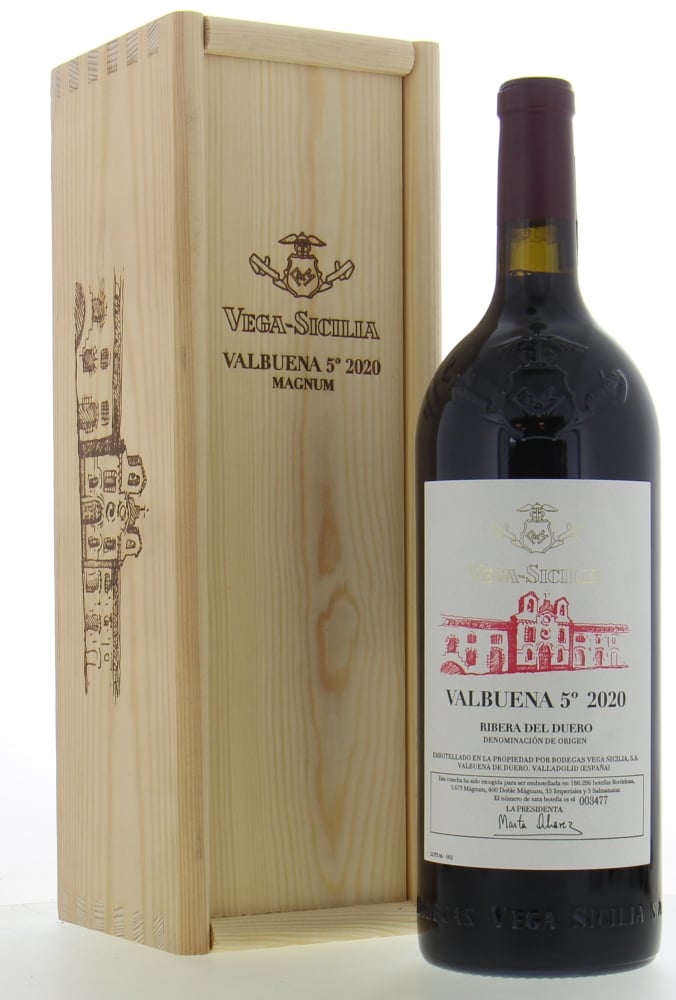
| Volume | Magnum |
| Classification | Cru Classe |
| Type | Red |
| Producer | Vega Sicilia |
| Wine | Valbuena |
| Vintage | 2020 |
| Country | Spain |
| Region | Ribera del Duero |
| Grape | Tempranillo |
| Volume | 0,75 |
| Condition | Perfect |
| Label | Perfect |
| Drinkable | 2025-2040 |
| Stock | 17 |
| Volume | 1,5 |
| Condition | Perfect, From Original Wooden Case |
| Label | Perfect |
| Drinkable | 2025-2040 |
| Stock | 1 |
The 2020 growing season in Ribera del Duero brought exactly what Vega Sicilia needed. A cool, wet spring was followed by a dry summer with perfect temperature swings. For Valbuena 2020, this meant long aging times and concentrated fruit from vines averaging 35 years of age. The late harvest allowed the tempranillo to acquire the complexity that critics such as Robert Parker and Jancis Robinson have praised in this vintage. The result is a wine that shows both the power of a warm year and the finesse that comes from patient maturation.
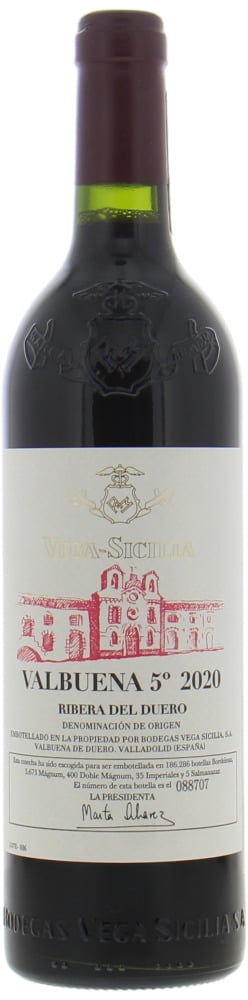
The 2020 Valbuena is from a year marked by COVID-19 and lots of rain before the harvest, which resulted in a more ethereal wine, with 14% alcohol, a pH of 3.9 and 4.45 grams of acidity. It was produced with 97% Tinto Fino and 3% Merlot, cooled down for 24 hours and then fermented with indigenous yeasts from a pied de cuve in stainless steel. It matured in barrel and oak vats during the first year, and in the second one, it aged exclusively in oak vats of different sizes, 8,500 and 21,000 liters. In 2020, the wine is finer-boned, it's more fluid, it's only medium-bodied, perhaps because of the dilution from the rain, and the tannins are fine-grained and polished, but there's less juiciness in the wine. It calls for food. With time in the glass, the wine opens up and becomes more aromatic, and it even seems to gain juiciness and change texture. This is a production of 186,286 bottles, 5,673 magnums and some larger formats. It was bottled in May 2023.
Valbuena 5 used to be the baby Unico, and nowadays it is more like its younger brother with a lot of resemblance and just a bit less depth and tannins. Valbuena 5 comes from younger vines and sometimes different parcels from Unico. On the palate, this is more open and linear, while Unico is more profound and vertical. Notes of iron, blackberries, cedar, minerals and cocoa powder. Medium- to full-bodied with melted tannins and a long, long finish. Drinkable from 2025, but will hold for years.
97% Tinto Fino, 3% Merlot. From the famous Vega Sicilia vineyard, located between 720 and 930 m above sea level on a limestone marl soil. For the first year of ageing, barrels (80% French, 20% American). For the second year, 6,000- and 9,000-litre foudres. 6 months in stainless steel for blending and 30 months of resting in the bottle. Production: 186,286 bottles, 5,673 magnums, 400 double magnums, 35 Imperials and 5 Salmanazars.
It has been a year in which the vineyard gave less concentration, so the oenological work is impressive because the wine shows intensity, the presence of ripe black fruit and tannin that is sweet in the mid palate but ends up being drier on the finish. Very ripe black fruit and a touch of violet stand out. Little oak impact for the Valbuena style. This is one of the most tactile vintages and still has many years ahead of it. Dense texture, powerful, and still very primary for the average Valbuena. (FC)
Produced with a selection form the more ethereal parcels that don't deliver the power sought for Unico, Valbuena 5º is however much more than a younger sibling of the iconic wine. The 2020 vintage, a child of a challenging growing season, both due to natural and operational challenges (remember Covid?...), it is a great achievement of nuanced power and detailed complexity, with a luscious fruit core lined with oregano, dried sage and thyme. Dark chocolate and roasted coffee beans build a broody background layer while Assam and Oolong tea leaves add umami depth. Beautiful detail and depth to the tannins.

The first impression is of concentrated blackberry and black currant berries overlaid with cedar and tobacco notes of oak aging. On the palate, the Valbuena 2020 shows the concentration of this vintage. Dense dark fruit is balanced by fresh acidity that came from cool nights of ripening. The tannins are firm but fine-grained, indicative of long maceration and careful selection of fruit from mature vines. Leather, dried herbs and a characteristic Ribera del Duero mineral backbone. The finish shows notes of dark chocolate and spice from aging in French and American oak. The wine needs another 3-5 years to fully integrate, but its structure promises to be worthy of patience.
Tempranillo, referred to here as Tinto Fino, dominates, making up 97% of Valbuena 2020. Merlot 3 %. So why is this small percentage so important? Merlot adds texture and smooths out the austere character of young Tinto Fino when it is young, and with the 2020, the maturation period was long and both varieties have reached optimum phenolic maturity.
Best drinking window: 2027-2042. 2020 It has high acidity thanks to cool nights and firm tannins thanks to long maceration, and its structure is suitable for serious aging in the cellar. Valbuena was already aged for five years before release, but this vintage will benefit even more from aging in bottle, with storage at 12-15°C and waiting for the tertiary aromas of leather, tobacco and earth to emerge over the next decade while the fruit evolves from basic black fruits to more complex dried fruits and spices.
Vega Sicilia has been making wines worth aging since before Ribera del Duero existed as an official region. Founded in 1864 by Don Eloy Recanda, who trained in Bordeaux and brought his French skills back to Castile, the estate operated as an isolated experiment for over a century. But what changed everything? In 1982, the same year that Ribera del Duero gained DO status, it was acquired by the Alvarez family. They transformed Vega Sicilia from a curiosity to one of Spain's most respected wineries. Today, the estate is nearly 1,000 hectares, with only 210 hectares under vine, divided into 64 plots. Best of Wines believes that their approach to combining French techniques with Spanish terroir is a model of modern Spanish winemaking.
The vineyards are located in the north of the Castilian plateau at an altitude of 700-900 meters above sea level, known as Meseta Central. This altitude is very important. Summer daytime temperatures reach 40°C and drop to 15°C at night. These drastic changes allow for acidity and concentrated flavors. The soil here is a mixture of limestone rubble over a sandy subsoil mixed with quartz gravel, with perfect drainage due to the proximity of the river. Why is this important? Because the limestone creates a mineral structure, and the sand and gravel prevent waterlogging during wet springs like in 2020. Locals describe the local climate as "nine months of winter, three months of hell", and for Valbuena these extremes create a tension between strength and elegance that characterizes the great Ribera del Duero.
After fermentation in wooden vats with indigenous yeasts, the Valbuena 2020 wine undergoes its characteristic 5 years of aging, starting with 225 liter French and American oak barriques (new and used) and then the wine is gradually transferred to different tanks. In the final stage, large wooden vats are used to give volume without overburdening the fruit flavors. And here is the important part: there is no set formula. Each vintage is given a different barrel treatment according to the characteristics of the year. This flexibility allows for a balance between the natural intensity of the wine and the integration of oak.
The backbone of this wine requires proteins, especially fat and char from grilled meats. In the traditional Castilian dish of lechazo (roasted lamb), the fat from the lamb melds with the tannins of the wine. For game, venison with juniper and rosemary. The herbs complement the oak-aged cedar notes. Spanish chorizo also pairs well with aged manchego cheese. This wine needs to be rich and flavorful to stand up to its intensity; serve at 16-18°C and decant for at least one hour before service.
With track & trace code