| Classification | Cru Classe |
| Type | Red |
| Producer | Rayas |
| Vintage | 2022 |
| Country | France |
| Region | Rhone |
| Grape | Rhone Blend |
| Volume | 0,75 |
| Condition | Perfect |
| Label | Perfect |
| Drinkable | -2036 |
| Stock | 0 |
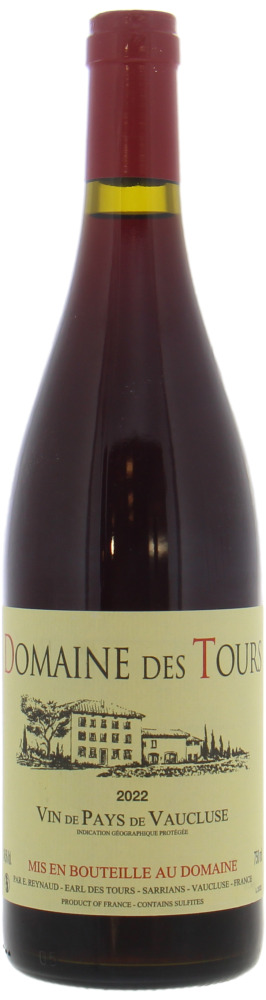
Pure Grenache from the Vaucluse, made by Rayas. The grapes were harvested from very old vines, and this is the essence of this wine: it features a concentrated flavor without being heavy, characterized by crisp red fruit aromas that aren't jammy or muddled.
In the southern Rhône region, 2022 was an early-harvest year, with the harvest of grapes for white wine beginning in mid-August. Further north, in the Côte-Rôtie region, there was slightly more rainfall.
Aging takes place in the cellars of Château Rayas and Château des Tours. No new oak barrels were used at all; instead, large foudres (large, old wooden barrels), most of which are over 70 years old, were primarily used.
It is best enjoyed by 2036. Decant the wine when young.
Initially, aromas of crushed raspberries and dried strawberries emerge, followed by notes of wild herbs and a dry, dusty scent reminiscent of sand rather than stone. On the palate, Château des Tours Vaucluse 2022 maintains a light feel; the acidity is gentle, and the alcohol content isn't as pronounced as one might expect given the heat of that year. The tannins are firmer than the fruit flavors suggest. As a small-berry wine, the flavor of the skins is more pronounced than that of the juice. Currently, the tannins are somewhat astringent, so it's best enjoyed with food rather than on its own.
Most southern Rhône red wines are primarily made from Grenache, with Syrah, Mourvèdre, or Cinsault added to enhance color and astringency. On sandy soil, it gives Chateau des Tours Vaucluse its red-fruited character and perfumed lift rather than dark, tarry depth.
Best enjoyed by 2036. Tannins, rather than acidity, are the defining characteristic of this wine. Since the 2022 vintage was made from grapes with thick skins and small berries, the astringency will take time to mellow. We recommend decanting for about an hour and serving at 16-18°C. Store the bottle in a cool, undisturbed place.
A northeast-facing vineyard with sandy, poor soil, surrounded by oak and pine trees: Château Rayas is located in the heart of Châteauneuf-du-Pape, and thanks to these trees and the exposure, the vines enjoy a relatively cool microclimate. The vineyard's area, which is just under 10 hectares, is planted exclusively with Grenache and Clairette. Yields are kept below 20 hl per hectare.
Albert, who lost his hearing at the age of 45 (which led him to give up his career as a notary and take up viticulture), founded Rayas in 1880, and his son, Louis, subsequently acquired Château de Fonsalette and the approximately 40-hectare Château des Tours. Since 1997, Emmanuel Reynaud, representing the fourth generation, has been managing all three estates. In the wine cellar, the grapes undergo natural fermentation in concrete vats, after which the wine is aged for several months in old French oak barrels. However, bottles are rarely seen on the open market; most of the production is sold through allocation.
Château des Tours is the largest of the three family-owned vineyards, covering approximately 40 hectares, significantly larger than Château Rayas itself. The sandy, infertile soil plays a key role. The well-drained soil keeps yields low, lending Grenache more aroma than volume.
Thanks to the massive oak and pine trees surrounding the vineyards and the northeast-facing terrain, the vines grow in a relatively cool microclimate. Yields are kept below 20 hectoliters per hectare.
Whole grape clusters are placed in concrete fermentation tanks and fermented with natural yeast. Concrete naturally maintains a stable temperature, which is ideal for the Grenache variety, as high fermentation temperatures can lead to overripe and jam-like flavors.
It is then aged in old French oak barrels. Months, not years of new-barrel polish. Since Château des Tours Vaucluse undergoes no clarification or filtration before bottling, it may develop a light sediment.
A harmony of red fruits, herbs, and firm tannins: that combination wants fat and salt.
It's best to avoid dishes with delicate flavors. The wine's tannins can make those flavors seem flat.
With track & trace code