

Massetino
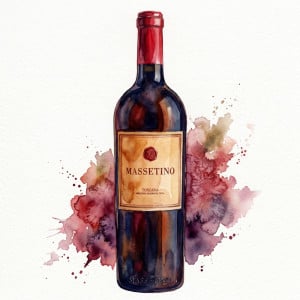
Massetino is the second wine of Masseto, and that fact alone tells much of what you need to know. Hailing from one of Italy's most coveted vineyards, the legendary blue clay hills of Bolgheri on the Tuscan coast, Massetino offers a taste of Masseto's DNA without having to wait years on the list. The first vintage was released in 2017. So why make a second wine? Because not all vineyards and barrels have the profile that Masseto seeks. Massetino bottles these lots, primarily Merlot with Cabernet Franc, under the Tuscan IGT label. The wines drink earlier and are more affordable, but carry the unmistakable handwriting of the hills above the sea.
About Masseto
Masseto is a rare domaine among the great ones. So why release a second brand? Because the team wanted to find a way to represent the vineyard under a more familiar registered trademark without diluting the grand vin. The estate is located in Bolgheri on the Tuscan coast and has been managed by the Frescobaldi family since 2005; in 2018, Masseto opened a dedicated Gravity Flow winery, partially buried underground, on a hillside adjacent to the vineyard. The project is currently overseen by the estate's director, Giovanni Geddes da Filicaja. We believe that Massetino is one of the smartest second wines in Italy, true to its region and drinkable much younger than its older counterparts.
History & Heritage
Massetino came on the scene in 2017, more than 30 years after Masseto's debut in 1986. That history is important because for years Masseto refused to produce a second wine at all. So what changed? The team wanted to offer drinkers a way into Masseto's vineyards that didn't require deep pockets or long waits; Axel Heinz, who oversaw winemaking until 2023, formed Massetino's initial identity, and the opening of a new gravity cellar in 2018 gave the project the precision it needed. What this means for buyers is that Massetino is not a sellout. It is a thoughtfully crafted wine made from lots carefully selected by the same hands that made Masseto.
Terroir & Climate
The blue Pliocene clay here, called Argille Azzurre, is found on south- and southwest-facing slopes at about 120 meters above sea level. Why is this clay important? Because of its water retention properties. The dry, warm summers of the Tuscan coast mean that Merlot ripens slowly and steadily without withering, even in dry years. The Tyrrhenian Sea is only a few kilometers away, and winds from there cool the days and prolong ripening into the evenings. The wine gains concentration without feeling stewed or jammy. Blue clay is also rare. Most of Bolgheri is on gravel and sand. The hill is a geological anomaly, and the wine's flavor matches it.
Grape Varieties
Massetino's blend is approximately
- 90% Merlot
- 10% Cabernet Franc
Merlot provides the base, giving Massetino a soft texture, dark plum fruit, and a rounded middle. What does the Cabernet Franc do? Cabernet Franc lifts the aromatics, adding a graphite edge and herbal freshness that keeps the wine from feeling too heavy. Cabernet Franc has been part of the blend since the first vintage in 2017. Without the Cabernet Franc, the Massetino's flavors are broader and softer. With the Cabernet Franc, the wine has a spine.
Winemaking
The decisive choice is restraint. Massetino is aged in French oak barriques for about 24 months, but the percentage of new oak is less than in Masseto, where the Grand Vin is aged entirely in new oak. Why reduce it? Because this wine is intended to be consumed quickly, and aggressive oak would mask the fruit appeal of the ripe Merlot. Fermentation is done by parcel and each section is vinified separately, allowing the team to taste and select wines before blending; the 2018 Gravity Cellar allows the wine to move without pumps, preserving tannins. The result is a wine that doesn't feel too early to open at five years old.
Tasting Notes
First, the aroma is impressive. Ripe black plum and morello cherry from the Merlot, violets and graphite from the Cabernet Franc. There is sweet spice from the oak, but it is behind rather than on top of the fruit. Silky and deep, with the velvety smoothness that only Blue Clay Merlot can offer. The tannins are present but refined, and the acidity keeps the whole thing tight. The finish is savory, with almost iron-like nuances that lead straight back to the soil. Young wines drink well when well decanted. Older bottles add tobacco, leather and dried figs.
Food Pairing
To the soft tannins and dark fruit of the wine, you want to add protein and fat. Taste:
- Bistecca alla Fiorentina, traditional Tuscan bone-in meat, charred on the outside, rare on the inside.
- Wild boar ragout (cinghiale) over pappardelle.
- Tuscan beef peposo, slow-cooked with black pepper, echoing the spiciness of the wine.
- Aged pecorino Toscano. The salt enhances the wine's roundness.
Serve at 17°C. Avoid dishes with high acidity or strong flavors as they will flatten the wine.
Serving Suggestions
At 16-18℃. The higher the temperature, the more the alcohol comes to the fore. Decant young wines for at least 1 hour; 30 minutes is sufficient for bottles older than 10 years. A large Bordeaux glass is best. This allows the aromas to develop.
Vintages
Massetino is still a young project, the first vintage was released in 2017. Warm, dry years tend to result in a more opulent and fruity Massetino, which is generous from the start. Cooler, more challenging years, such as 2023, with a wet spring and an outbreak of mildew throughout Tuscany, produce slimmer, more flavorful wines with more emphasis on Cabernet Franc. Bolgheri's coastal location was an advantage in 2023, when inland Chianti suffered. Warmer years are best for early consumption. If kept in the cellar, a well-structured vintage will age gracefully for 5-10 years. Consistency is the hallmark of this hill.

Cellaring Potential
Massetino drinks well about 5 years after harvest and keeps for 15-20 years. The blue clay gives the Merlot true concentration, while the Cabernet Franc adds the acidity and structure needed for aging. Ideally, it should be kept at 12-14°C in a cellar with stable humidity. Over time, the primary fruit aromas recede and tertiary aromas (tobacco, leather, dried herbs) come to the fore. Patience is rewarded, but it is not necessary to wait as long as with Masseto.
