

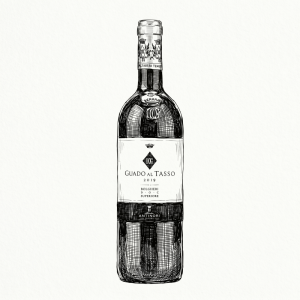
Guado al Tasso
Guado al Tasso is Antinori's flagship wine in Bolgheri and an interesting companion. The family became famous for their Tignanello and Solaia wines in the hills of Chianti Classico, but this wine is from a completely different place, the Maremma coast facing the Tyrrhenian Sea.
What's the difference? Bolgheri does not produce Sangiovese regularly. The soil, the sea breeze, and the warmth of the Mediterranean all favor the Bordeaux variety. Guado al Tasso is a blend of Cabernet Sauvignon, Merlot, and Cabernet Franc, with Petit Verdot added in some years.
The vineyard is located in a natural amphitheater of rolling hills facing the coast. This geographical situation is more important than one might imagine. I will explain why in more detail in a moment. For now, know this: Guado al Tasso is the most authentic wine of the Bolgheri Superiore DOC.
About Antinori
Marchesi Antinori dates its wine business to 1385, when Giovanni di Piero Antinori joined the Arte Fiorentina dei Vinattieri, the Florentine winemakers' guild. The family goes back further still: a Rinuccio di Antinoro is recorded making wine at the Castello di Combiate, north of Florence, around 1180. The castle was destroyed in 1202, the family moved into Florence, and for a while wine gave way to silk and banking
For centuries it stayed a sideline next to silk, wool and banking. Then came Piero Antinori, the 26th generation, who broke the Chianti Classico rulebook with oenologist Giacomo Tachis. Cabernet Sauvignon and Cabernet Franc planted in Val di Pesa, aged in barrique, sold as simple table wine because the rules left no other option. That was Tignanello, released in 1974, followed by Solaia in 1978 and Guado Al Tasso from Bolgheri in 1990. The headquarters sit at Bargino, about 30 kilometres south of Florence, between Florence and Siena. Classic Chianti and Super Tuscans, both from the same house.
History & Heritage
Tenuta Guado al Tasso has been in Antinori hands since 1830, but for most of that time it was not a winery. Bolgheri itself was not even taken seriously until the late 1960s, when Sassicaia changed the subject.
So what made the difference? The Sassicaia family, seeing what was happening in neighboring domains, decided that Bolgheri deserved its own flagship, and in 1994 it was granted DOC status, followed by Bolgheri Superiore. Since then, Guado al Tasso has carried on the Superiore title.
Terroir & Climate
Guado al Tasso is located on the natural hillside overlooking the Tyrrhenian Sea, in the Bolgheri amphitheater. It is about 5 km from the sea. Significantly close.
Why is this geography important? There are two reasons. First, the sea breezes keep the vineyards cooler than the average Tuscan temperature, delaying grape ripening and preserving acidity. Second, the diurnal variation (warm days and cool nights) enhances the flavor of the grape skins.
The estate has a total area of approximately 1,000 hectares, of which about 320 hectares are planted at an altitude of about 50 meters above sea level. The soils are alluvial, sandy clay mixed with marine sediments and gravel. The soil is well drained, which is necessary for Cabernet Sauvignon.
Grape Varieties
The blend varies slightly from vintage to vintage, but the structure is consistent. Approximate proportions:
- About 55% Cabernet Sauvignon provides structure and cassis.
- Merlot, about 30%, adds fullness and mid-palate.
- Cabernet Franc, about 10%, provides floral notes and graphite.
- Petit Verdot, up to 5% in some years, gives color and spice.
Why this blend in Bolgheri? Cabernet Sauvignon ages more reliably hotter than Medoc, which softens the tannins. The Merlot brings out the angularity of the wine.
Winemaking
The key choice is isolation. Each variety and each area within each variety is fermented separately. Why is this necessary? Because the alluvial soils within the estate vary greatly over short distances, and having one fermentation tank allows us to smooth out these differences.
Blending is done after fermentation so the team can see how each batch is doing. The wine is then aged in French oak barriques (225-liter Bordeaux-type barrels) for 14 to 18 months, mostly new (usually 50-60%).
The new oak is enough to give the wine structure and add layers of cedar and vanilla, but Guado al Tasso is concentrated enough to absorb the wood flavors without being overpowering.
Tasting Notes
The first aromatic notes one notices are blackcurrant and ripe black cherry, followed by Mediterranean herbs, graphite, and a savory note of sweet tobacco. The Cabernet Franc has a purple hue.
On the palate, Guado al Tasso is full-bodied but not heavy. The tannins are firm but refined, more rounded than those of the Medoc, a Bolgheri specialty. The finish is long and slightly salty, with dark plum from the Merlot, cedar from the oak, and perhaps a maritime influence.
It is suited to aging, but does not close up in its youth.
Food Pairing
The tannins want protein and fat. Rising Cabernet Franc wants herbal and spicy. Some effective ideas:
- Bistecca alla Fiorentina, a classic combination. Bistecca alla Fiorentina, a classic combination.
- Pappardelle with wild boar ragout (cinghiale)
- the richness of the game matches the savory notes of the wine.
- Roasted leg of lamb with rosemary and garlic.
- Aged Pecorino Toscano, a beautiful contrast between the saltiness and the wine's maturity.
Served at 16-18°C.
Serving Suggestions
Guado al Tasso should be served at 16-18°C. The higher the temperature, the more the alcohol comes forward. Decant young wines for at least 90 minutes; 30-45 minutes is sufficient for bottles older than 10 years. An ordinary Bordeaux glass is sufficient. No need for expensive ones.
Cellaring Potential
Guado al Tasso is usually ready to drink 5 to 7 years after harvest and can be aged for more than 20 years in a good cellar environment. The reason for this? The firm tannins of the Cabernet Sauvignon, the moderate acidity due to the maritime climate, and the concentration characteristic of the low-yield vineyards of Bolgheri.
Store at a stable temperature of 12-14°C and away from light. Over time, the primary fruitiness gives way to leather, tobacco, and dried herbs.
