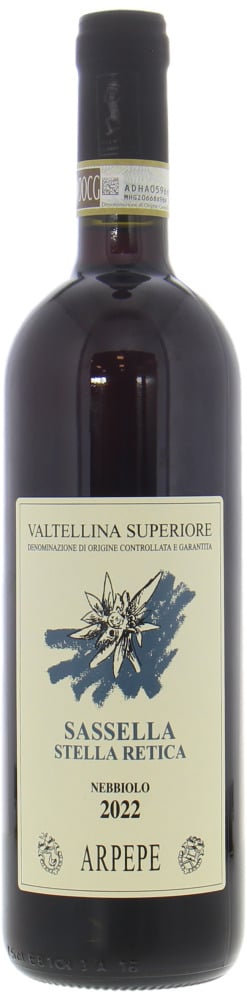
| Classification | DOCG |
| Type | Red |
| Producer | ARPEPE |
| Vintage | 2022 |
| Country | Italy |
| Region | Lombardy |
| Grape | Nebbiolo |
| Alcohol % | 13.5% |
| Volume | 0,75 |
| Condition | Perfect |
| Label | Perfect |
| Drinkable | 2027-2042 |
| Stock | 20 |
The 2022 growing season in Valtellina was warm and dry, part of a general trend across Northern Italy for Nebbiolo to ripen earlier than usual. On the steep granite terraces above Sondrio, the fruit was smaller and the juice more concentrated, but the high altitude and cool nights maintained the acidity characteristic of Sassella. For Stella Retica, the most accessible Sassella in the ARPEPE range, the 2022 is a vintage with more fruit mass than in colder years, but with an undiminished alpine lift.
A floral, smoky and savory wine with a leesy character and aromas of incense, stony minerality and fresh strawberries. Medium-bodied, it shows velvety tannins, crisp acidity, a supple palate and a juicy, slightly lifted finish. Drinkable now, but best in two or three years.
The 2022 Valtellina Superiore Sassella Riserva Stella Retica is an absolute delight. Aromatic and vibrant, with terrific presence, the 2022 is all class. Dark red/purplish fruit, blood orange, pomegranate and orange peel are all sculpted in the glass. This is such an elegant and polished wine.
Light ruby red colour with a brighter rim. Fine, clean nose of forest fruits, clearly blackberry and redcurrant, hints of coffee and blood orange. Dense on the palate, with measured tannin, medium palate drive and a remarkable finish.

First impressions: rose petals and wild raspberries, with characteristic Sassella notes of iron and stone. Red cherry and dried herbs, orange zest, the tannins are subtle but persistent. The finish is savory, almost salty, you can drink it now after an hour's airing, but it will show its best after another year or two of bottle aging. Pale garnet color, typical of Nebbiolo at this altitude.
Stella Retica is 100% Nebbiolo and is called here Chiavennasca, after the town of Chiavenna in the western part of the valley. So why do the same grapes used to make Barolo taste so different in Sassella? Altitude and granite. The shallow, sandy acidic soils at 300-700 meters altitude allow Nebbiolo to ripen later, resulting in wines that are paler, more floral, lower in alcohol and higher in acidity than their Piemontese counterparts.
Best ripening period is 2026-2035, but can continue beyond that given the structure. Stella Retica is produced as an early drinking wine in the ARPEPE Sassella range, but the natural acidity and Nebbiolo tannins give this wine real legs when stored at around 12-14°C. Aging adds dried rose, leather and tar to the main red fruit flavors.
Many people know Nebbiolo from Barolo. Few know Nebbiolo, which is produced on nearly vertical terraces of granite south of the Swiss border, 700 meters above sea level. ARPEPE has held its beliefs since 1860, and especially since 1984, when Arturo Pellizzatti Perego founded the estate under his initials. The estate is now run by his three children, Isabella, Emanuele and Guido. Best of Wine believes that ARPEPE produces the most extraordinary Nebbiolo in Italy outside of Piedmont.
Sassella is located west of Sondrio, in the shallowest and rockiest of the five subzones of Valtellina Superiore. The soils are decomposed granite, sand, shale and contain little organic matter. This is why the wines of Sassella are so mineral. Because the valley stretches from east to west, which is rare in the Alps, the south-facing terraces are exposed to the sun all day long and cool breezes from the north keep the grapes fresh. The terraces are supported by dry stone walls. There are a total of 2,500 kilometers of UNESCO-listed dry stone walls.
ARPEPE's characteristic move is what they don't do. No barriques, no new oak, no barrel toasting. Spontaneous fermentation, long, gentle maceration and aging in big old botti (traditional large oak barrels) of Slavonian and French oak. In the case of Stella Retica, this means about two years of aging in barrels before bottling. You taste the flavors of fruit, earth and time. Not wood.
What the wine needs: savory fats, not heavy sauces. The high acidity cuts through the richness, and the fine tannins seem to capture some protein. Try it with:
Serve at 16-18°C. Decant lightly.
With track & trace code