

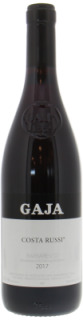
Costa Russi
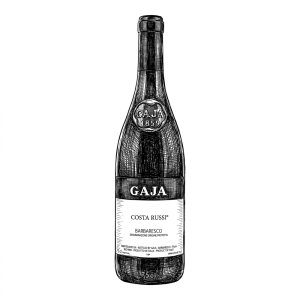
Costa Russi is one of three single-varietal Nebbiolo wines that have made Gaja famous beyond Italy’s borders. First released in 1978, this wine is produced on the southern slope of the Roncagliette hill in Barbaresco, and for several decades its label did not bear the designation “Barbaresco DOCG,” but “Langhe DOC.” The reason for this lay in the Gaja family’s stubbornness. Angelo Gaja continued to insist on adding a small amount of Barbera, which was not permitted under the appellation’s rules. Starting with the 2013 vintage, “Costa Russi” once again became 100% Nebbiolo and regained its Barbaresco DOCG status. This wine ranks among the best of Piemonte—the great Barolo from Serralunga and the legendary Barbaresco crus from Treiso. And it remains one of those wines you want to turn to first when you want to understand what modern Piemonte is all about in a bottle.
About Gaja
Gaja is a producer often referred to as the well-deserved leader who brought Piemonte into the modern era. Angelo Gaja, after studying winemaking in Alba and Montpellier, joined the family business in 1961 and took over its management by 1970. He was the first in the region to introduce stainless-steel tanks with temperature control systems. At a time when Slovenian-made barrels were considered the norm, he actively introduced 225-liter French barriques. Furthermore, at a time when the local tradition was to blend grapes from across the entire estate, he created a Barbaresco from grapes grown on a single specific plot. The reason we always keep Gaja wines in stock is the sheer quality of the wines: the crreation of a Nebbiolo that combines such precision and individuality. Today, his children, Gaia, Rossana, and Giovanni, lead the day-to-day operations.
History & Heritage
Three wines from a single vineyard, the 1967 “Sorì San Lorenzo,” the 1970 “Sorì Tildin,” and the 1978 “Costa Russi”, laid the foundation for this family’s international fame. “Costa Russi” was the youngest of these three wines, but it soon became just as popular among collectors as the other two. From the late 1990s through the 2013 vintage, there was a long period during which a small amount of Barbera was added to the blend, leading to a transition to the “Langhe” DOC. This move sparked controversy. Many traditionalists believed that Gaja had abandoned the DOCG designation out of pride. In 2013, this chapter came to a close with a return to 100% Nebbiolo and Barbaresco DOCG. For consumers, this means that bottles released before and after 2013, although stylistically related, are legally entirely different wines.
Terroir & Climate
Costa Russi is located on the Roncagliette hill in the village of Barbaresco itself. The soil here consists of calcareous marl mixed with limestone, a composition typical of the Langhe region that gives Nebbiolo its robust structure and floral aroma. The slope faces south, which is an important factor in Piemonte, as the Nebbiolo grape ripens slowly, often not until October, and therefore needs every extra hour of autumn sunlight. Compared to Barolo, the soil in Barbaresco contains more sand. As a result, Barbaresco wines, including “Costa Russi,” have a slightly lighter flavor and generally reach their peak drinking window sooner. It is precisely the cool nights following hot days that allow this wine to retain the high acidity characteristic of it in the glass.
Grape Varieties
Currently, “Costa Russi” is made from the following grape varieties:
100% Nebbiolo
Nebbiolo is the only grape variety in Piemonte used to produce this prestigious wine, and it embodies all of its distinctive characteristics. These include the nose-tingling aromas of red berries and roses, the nuances of tar and leather that emerge as the wine ages in the bottle, and a robust tannic structure. The wine’s color is relatively light; it’s closer to Pinot Noir than to the red wines of southern Italy. It is precisely its structure that reflects the true value of this wine.
Winemaking
The winemaking method that Gaja applies to single-vineyard Nebbiolo has remained unchanged for several decades. The wine is aged for about a year in 225-liter French barriques, and then, before bottling, is transferred to larger Slovenian-made oak barrels for another year. During barrel aging, the wine develops structure and light spicy notes without losing the aroma characteristic of the variety. Aging in botti softens the wine and harmonizes all its components. In the vineyards, yields are kept low through high planting density and careful fruit thinning during the growing season. This may sound like a typical example from a winemaking textbook, but limiting yields is of paramount importance in this case. It is precisely this low yield that gives “Costa Russi” its concentration, thanks to which the oak notes do not come to the fore even after two years of aging in oak barrels.
Food Pairing
Since this wine is dominated by acidity and tannins, it pairs well with dishes rich in fat and protein. Recommended pairings:
- “Tagliatelle” pasta with white Alba truffles. This is a classic pairing typical of the region
- Brasato al Barolo (beef braised in red wine). The wine harmonizes well with the flavor of the sauce
- Roasted mountain partridge or wild boar ragout. Game pairs well with the tannins
- Aged Castelmagno or hard Alpine cheeses
Avoid seafood and sweet dishes, as this wine overpowers their delicate flavors and does not pair well with sugar.
Serving Suggestions
Serve at 16–18 °C. Typical room temperature in the home is too high, which will make the alcohol taste too strong. Young “Costa Russi” wine should be decanted for at least 2 hours, while aged wine (15 years or older) should be decanted for 30–45 minutes to allow the bouquet to unfold without losing the subtle aromas developed during aging. Burgundy-style glasses with a wide bowl are more suitable than narrow Bordeaux glasses. This provides enough space for the aroma to fully develop.
Vintages
Costa Russi is worth trying to appreciate the unique characteristics of each vintage. In warm vintages, such as 2009, fruity notes come to the fore, the tannins are ripe, and such wines can generally be enjoyed at a young age. In cooler vintages with a firm structure, such as 2015, the acidity stands out; these wines require longer aging but generally have great aging potential. The 2017 vintage is a warm one, and for those who can’t wait, this wine is already ready to drink. The 2021 vintage is one in which the modern style characteristic of wines since 2013 has fully come into its own.
If you want to enjoy wine as part of your everyday life, choose vintages that are at least 10 years old. If, on the other hand, you’re aiming for full-fledged aging, it’s the vintages with a robust structure that will bring you long-term enjoyment. Older vintages are generally more expensive, partly due to their rarity and partly because aged Nebbiolo represents a distinct category of its own.
The best vintages of Gaja Sori San Lorezo
The level and quality of this wine is very high, regardless of vintage, However, some exceptional vintages are: 1990, 1997, 2004, 2007, 2013, 2016, 2021, 2022.
Cellaring Potential
Best enjoyed 5 years after release and up to 25 years or more in certain vintages. The tannins still need time to mellow, but thanks to its high acidity, the wine will retain its freshness for 20 years. Store at a stable temperature of 12–14 °C, ideally in a horizontal position, away from light and vibration. As it ages, the initial aromas of red berries will gradually give way to notes of dried roses, truffles, and tar. The wine’s structure will also evolve from firm to silky, and this is precisely where the charm of aging lies.
