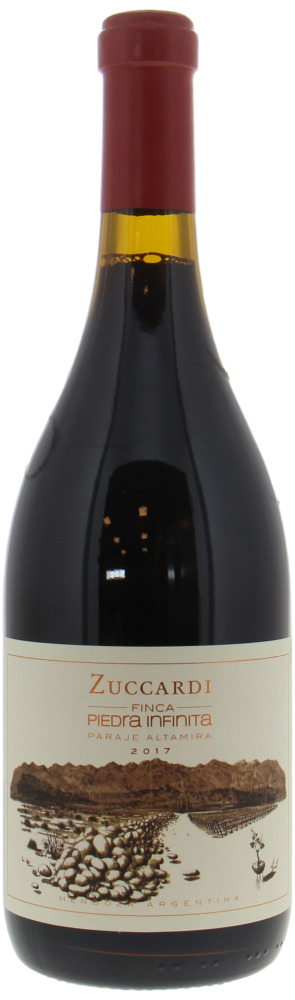
| Classification | Cru Classe |
| Type | Red |
| Producer | Zuccardi |
| Vintage | 2017 |
| Country | Argentina |
| Region | Mendoza |
| Grape | Malbec |
| Alcohol % | 14% |
| Volume | 0,75 |
| Condition | Perfect |
| Label | Perfect |
| Drinkable | -2032 |
| Stock | 18 |
The 2017 growing season in Paraja Altamira was warm and dry, and the Zonda winds brought an early harvest in much of the Uco Valley. For the Finca Piedra Infinita vineyard in Zuccardi, this meant small berries and concentrated fruit from a calcareous, stony alluvial vineyard located at about 1,100 meters elevation. The result is denser than the cooler 2016 vintage, but with the saline tension characteristic of this single vineyard Malbec.
They use some specific soils for the 2017 Finca Piedra Infinita, up to eight different plots, but not all plots contribute to the wine every vintage; in general, the zones with 20 to 60 centimeters of soil and then large stones with calcium carbonate are reflected in the wines. So, they deconstruct the vineyard, and then they build the blend with the plots they like for each wine, up to eight here but only a specific one for the Supercal and Gravascal. There's a little more ripeness and exuberance here within the general austerity of the whole Piedra Infinita range, especially when compared with the 2018s. They harvested 15 to 20 days earlier than in 2018 (or in 2016) and they had to run, but the separation they have by soil helped them to harvest earlier the earlier-ripening parts of the vineyard. That gave them a great advantage and they produced very good 2017s, but the condition of the year, a shorter cycle and a more hurried year was what it was. This 2017 is not as long as the 2018, and there is a strong chalkiness in the finish. 7,300 bottles were filled in August 2018.
This is very intense with blackberry and blueberry character, as well as hot stones and granite. Full body. Chewy tannins fan out across the palate. A serious, powerful wine. Needs at least four or five years to soften. Impressive.
The first impression is an aromatic lift rather than a heavy one. Violets, raspberries, blueberries, and a bunch of dried Andean herbs cover something distinctly chalky, almost salty. On the palate, Finca Piedra Infinita 2017 is meatier than usual, perhaps due to the warm season, but the tannins remain fine and stony rather than opulent. The finish is long and mineral. If you open a bottle now, we recommend decanting it for at least an hour.
It is a cepage, 100% Malbec.
So why no blending partner? Because the point of Finca Piedra Infinita is to read the soil, not the cellar. The Malbec of Palaje Altamira behaves differently from the lush, oaky Luján de Cuyo style. Add Cabernet or Bonarda and the signals would be muddled. Sebastian Zuccardi wants the vineyard to speak for itself.
Drink between 2025 and 2032. The young 2017 wines are more approachable than the cooler vintages thanks to their riper fruit, but the chalky tannins and bright acidity guarantee another 10+ years in bottle. store at 12-14°C. After 2028, the wines turn to dry herbs, leather and more pronounced minerals. After 2028, it will turn to dry herbs, leather, and more pronounced minerality.
The Zuccardi company did not start with wine. It began with irrigation. Alberto Zuccardi planted vines in 1963 to demonstrate the system he had invented. Three generations later, Sebastián Zuccardi led the farm from the old, powerful, oaky style of Argentine Malbec to a leaner, more site-specific style. 2019-2021, Zuccardi's Valle de Uco vineyard will be the world's best for the third consecutive year Certified. Best of Wines believes this shift makes the most sense for single vineyard wines like Finca Piedra Infinita.
The vineyard's name, Piedra Infinita (Infinite Stone), speaks volumes. Before the trees could be planted, more than 1,000 truckloads of stones had to be removed. What was left was a shallow sandy area overlying a large granite subsoil covered with calcium carbonate (limestone). Why is this important? Limestone retains moisture and gives Malbec a chalky, salty color that cannot be obtained from clay. Add to this the daily temperature difference of 15-20°C and annual rainfall of about 250 mm, and you get freshness, not jam.
Sebastian Zuccardi ferments his wines with indigenous yeasts in unfired concrete tanks and then ages them in concrete. Why? Because oak, even neutral oak, imparts textures and aromas comparable to the limestone that characterizes Paraguay Altamira. Concrete is inert. It does not allow the wine to breathe and impart flavor. The trade-off is that the tannins lose their hiding place, so the work in the vineyard must be relentless. You taste the flavors of the terroir.
Argentine asado is the obvious answer, and the right one. Try it:
Serve at 16-18°C. Decant one hour before serving.
With track & trace code