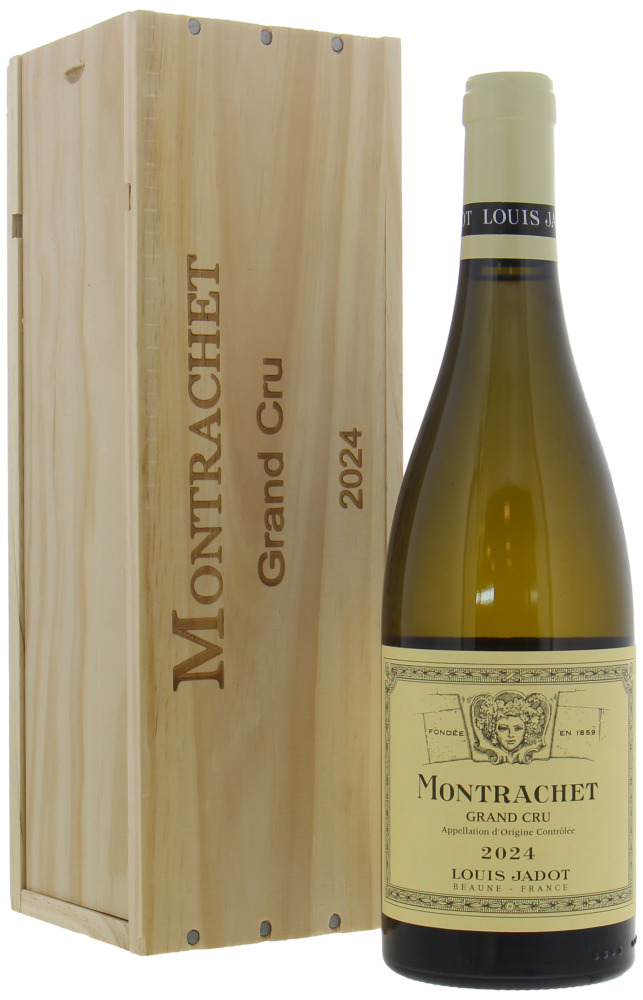
Two 350-liter barrels. This represents the entire 2024 production of Le Montrachet from Louis Jadot in Côte de Beaune.
Although the growing season began early due to a warm winter, there was some frost damage, and hail damaged certain areas (the northern part of Marsannay and specific areas of Chassagne). The resulting conditions are reflected in the yields: approximately 30 hl/ha in Côte de Beaune, compared to 9 hl/ha in Côte de Nuits. The harvest took place from the 13th to the 25th of September.
For Frédéric Barnier, in addition to the traditional 228-liter barrels, foudres and 500-liter barrels were used; since the barrels were filled for the fourth time rather than the usual third, the proportion of new barrels used was reduced.
This wine is best enjoyed between 2028 and 2048. When opened earlier, decant the wine for hours.
Robert Parker (96)
There are only two 350-liter barrels of the 2024 Montrachet Grand Cru (Maison Louis Jadot), another notable success in the range this year. Wafting from the glass with notes of pear, toasted nuts, peach and honeycomb, it's full-bodied, ample and satiny, suave and seamless, showing how well this site performs in more challenging years.
Winemaker Frédéric Barnier and his team have ably confronted the challenges of the 2024 vintage. As in 2023, Barnier stressed the importance of sorting and of vigilance during élevage. As I've written before, there have been evolutions in the cellar in recent years: foudres and 500-liter barrels now complement classic 228-liter pièces, making for better oak integration. What's more, barrels are now used four rather than three times, meaning the percentage of new oak overall has fallen. A cold room also helps chill down any fruit that's too warm when it enters the winery, something especially important during the warm 2023 harvest but obviously much less of a concern in 2024. Here, as at many other addresses, the whites are the stronger suit in 2024, but the reds are very honorable too.
Vinous (96)
The 2024 Montrachet Grand Cru has another well-defined nose, though juxtaposed against the Chevalier this does not contain the same amplitude or refinement. The palate is intense and broad-shouldered, the richness counterbalanced by the acidity. A little spicier than the Chevalier-Montrachet on the finish, this lingers in the mouth. A serious Montrachet that should give 20 or 30 years' drinking pleasure.
Burghound (94)
There is a discreet but not invisible touch of wood framing the reserved, pure and elegant spice, citrus zest, white orchard fruit and overtly floral nose. The broad-shouldered yet refined flavors aren't quite as concentrated as those of the Demoiselles but they do nonetheless project plenty of power on the muscular and overtly lemony finale that is also impressively persistent. This is also going to need extended keeping though that's true of any Montrachet worthy of the name.
Producer note: Technical director Frédéric Barnier, who is always an incredible wealth of information about each vintage, described the 2024 growing season as "one that began with a relatively warm winter that engendered an early start to the vegetative cycle. This of course always puts the risk of frost damage on the table and sure enough, there was some though nothing like the enormous damage done in 2016 or 2021. And then the skies opened and stayed open as it was just rain, rain and more rain! For example, there was 50% more rain than in 2023 and this made getting machinery into the vineyards almost impossible. The mildew didn't wait to attack, which it did in April, and it was thus no surprise that there were parcels that had yellowing leaving by May! There were more than 40 separate attacks of mildew, which is the most since 2012. June though was where the real damage was done. The chardonnay, as always, flowered earlier and while it wasn't perfect, it passed much better than the pinot as it suffered a huge proportion of shatter. To make matters worse, the Côte de Nuits suffered from even more rain than the Côte de Beaune, which made it even more difficult to get tractors in the vineyards to protect the foliage. July was scarcely better as controlling the explosive growth of weeds in the vineyards became a massively complicated undertaking and ultimately, the only solution was to cut them manually, which is effective but extremely slow, not to mention extremely laborious. On the plus side though, things began to look up in August as the véraison started between the 5th and 10th and the rain finally eased off. Otherwise, there weren't too many other problems with the exception of 10 to 30% hail losses that occurred in the northern part of Marsannay and parts of Chassagne. The beginning of September was fairly cool as the north wind began to blow, which helped significantly to limit the spread of rot but didn't do much for improving fruit maturities. Finally we had a week of clement and warm, though not hot, conditions that pushed the fruit to its final maturity levels. We picked from the 13th to the 25th of September, which turned out to be the perfect window as it began to rain again just as we were finishing! There was a low to moderate amount of sorting required, more so for the pinot as the chardonnay was for the most part clean. Yields were, not surprisingly, all over the place but as a general proposition, the farther south you went, the better they were. The Côte de Nuits though came in at only 9 hl/ha while the Côte de Beaune was on average around 30 hl/ha. With that said, the Hill of Corton was basically awful whereas the south around Santenay was not too far from normal. Potential alcohols averaged right at 12% for the pinot and around 12.5% for the chardonnay. We used no whole clusters for the pinot vinifications during the cuvaisons that lasted between 3 and 4 weeks. While we chaptalized lightly, we wanted to be very careful to avoid inadvertently unbalancing them. Curiously given the coolness of the growing season, total acidities were not high as there was a lot of malic that converted. For example, the pHs for the pinot ranged from 3.6 to 3.7, or about the same as the 2017 reds. The chardonnay ranged from 3.3 to 3.4 and I chose to block around 30% of the malos for some wines. As to the style of the wines, the reds are on the lighter side with relatively tender tannins and given the moderate pHs, they should be approachable on the younger side. The same could be said for the chardonnay and in terms of structure, they remind me of the 2022s. Overall, 2024 turned out better than we expected but I hope to never see another growing season like it!" Note that for the 2024 whites reviewed below that are in bottle, they were put there in January 2026 using the Diam brand composite cork.