
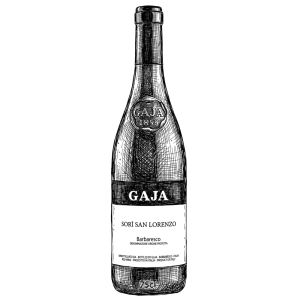
Sori San Lorenzo
“Sori San Lorenzo” is a wine that sparked a revolution in single-vineyard winemaking in Barbaresco. In 1967, Angelo Gaja released the first vintage, selecting a south-facing plot from his family’s vineyards and bottling the harvest from that plot separately. At the time, no one else in the village was doing anything like this. Barbaresco was associated exclusively with blends of any grapes grown on local estates.
This decision changed Piemonte. It was followed by “Sori Tildin” in 1970 and “Costa Russi” in 1978, which laid the foundation for the concept of Nebbiolo crus. “Sori San Lorenzo” is the oldest of these three wines and has the most robust structure; wine collectors often rank it alongside First Growth Bordeaux wines. The wine is made from 100% Nebbiolo grapes grown on the Secondine hills, located on the outskirts of the village of Barbaresco.
About Gaja
Although Gaja is not the oldest winery in Barbaresco, it was Gaja that brought this region into the modern era. Angelo, having studied in Alba, Montpellier, and Turin, joined the family business in 1961, and by 1970 he had been entrusted with managing the company. He was the first in the region to introduce temperature-controlled stainless steel tanks. He also began using 225-liter French barriques. Moreover, at a time when neighboring producers were still blending all grape varieties, he was already bottling wines from a single vineyard.
Currently, his children, Gaia, Rossana, and Giovanni, though Angelo, who is now over 80, has never officially retired. We work with Gaja's wines precisely because only a few producers like Gaja has shaped the character of this region to such an extent.
History & Heritage
An interesting twist in the history of Sori San Lorenzo is connected to the label itself. From 1996 to 2010, this wine was bottled as “Langhe DOC,” which is one tier below “Barbaresco DOCG.” Angelo added a small amount of Barbera to the blend, which was not permitted under the “Barbaresco DOCG” regulations. Therefore, he chose to forgo the designation of origin rather than exclude Barbera from the blend.
This approach came to an end with the 2013 vintage. Currently, “Sori San Lorenzo” is once again produced from 100% Nebbiolo and has returned to the Barbaresco DOCG category. The label change is significant for collectors studying older bottles; however, the wine itself, when poured into a glass, has not changed as much as these formal changes might suggest.
Terroir & Climate
Sori San Lorenzo is situated on the Secondine hill, located in the immediate vicinity of the village of Barbaresco. “Sori” means “south-facing slope” in the Piedmontese dialect, it is the sunniest spot in the Langhe region. This orientation is important because Nebbiolo is one of the latest-ripening grape varieties in Europe, and its harvest can extend into late October. On the southern slope of “Sori,” the grapes have time to fully ripen before the autumn rains and fogs set in.
The local soil consists of calcareous marl with a higher sand content than in Barolo, which is the structural reason why Barbaresco wines tend to be slightly lighter and more aromatic than those from neighboring Barolo. The cool autumn nights help preserve acidity well, allowing these wines to age for several decades.
Grape Varieties
Since 2013, “Sori San Lorenzo” has been produced from 100% Nebbiolo. Prior to that, Angelo had added a small amount of Barbera to the blend, which is why this wine was unable to obtain Barbaresco DOCG certification for nearly 20 years. A pure Nebbiolo from Barbaresco possesses all the qualities one could hope for. At first, aromas of red cherry and raspberry come to the fore, and as the wine ages, notes of rose, violet, tar, and tobacco emerge. It is precisely thanks to its high acidity and powerful tannins that this wine remains delightful even 30 years after bottling. Nebbiolo grown on the southern slopes (sori) has a fuller body and firmer structure than grapes grown in cooler regions.
Winemaking
Gaja’s winemaking method for single-vineyard Nebbiolo involves staged aging. First, the wine is aged for about a year in 225-liter French barriques, and then for another year in larger Slovenian-made oak barrels. The small barriques in the early stage give the wine structure and subtle spicy nuances. Transferring the wine to larger barrels then allows the components to harmonize without oversaturating it with oak notes. This hybrid approach, combining French refinement with Piedmontese traditions, was deliberately developed by Angelo following his trips to Burgundy and Bordeaux in the 1960s and 1970s.
Thanks to high planting density and careful green pruning, yields are kept low.
Food Pairing
Such robust tannins require fats and proteins to soften them. Here are a few excellent pairings:
- Tagliolini or risotto with white truffles from Alba. This is a classic pairing, but it is by no means a coincidence
- Brasato al Barolo: beef slowly braised in red wine until the meat becomes tender and falls apart
- Roasted pheasant or wild boar. Their aroma, imbued with a wild spirit, harmonizes beautifully with the wine’s leathery and tarry notes
- To finish the meal—an aged Castelmagno or hard Alpine cheeses
Serving Suggestions
Serve at 16–18 °C. This is slightly cooler than the typical living room temperature. Young wine should be decanted 2–3 hours before serving to allow the tannins to come into contact with the air and soften. Older wines, aged for more than 20 years, should be carefully decanted about 30 minutes before serving to separate the sediment and preserve the aroma. Using a Burgundy-style decanter with a wide bowl will help the aroma unfold. The cork should be removed before serving appetizers, not before dessert.
Vintages
Sori San Lorenzo is a wine that is more influenced by a specific vintage than the entry-level Barbaresco from the same winery. In warm years, such as 2020, the fruit notes become riper, the tannins rounder, and the wine can be enjoyed even at a young age. In vintages with a cooler climate and classic structure, such as 2022, the classic character is pronounced, and the wine needs to age in the cellar for at least 10 years to fully develop its aroma. Neither of these styles is “better”; they’re simply served differently.
If you’re looking for a wine to open within the next five years, try to find older vintages that have already undergone bottle aging. However, such wines are generally more expensive. If you plan to store the wine in a cellar, recent vintages are a sensible choice. That way, you can monitor the aging process yourself. In any case, this isn’t the kind of wine you’d want to open on a regular Tuesday.
The best vintages of Gaja Sori San Lorezo
The level and quality of this wine is very high, regardless of vintage, However, some exceptional vintages are: 1989, 1997, 2004, 2007, 2013, 2015, 2016, 2020, 2021.
Gaja
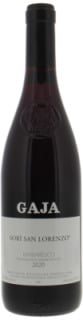
2020
€ 619,00 (ex Vat) € 748,99 (in Vat) more info
Gaja
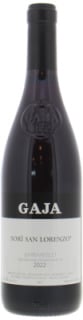
2022
€ 684,00 (ex Vat) € 827,64 (in Vat) more info
Gaja
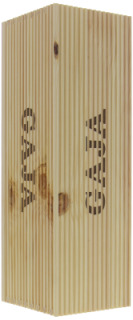
2020
(Magnum) € 1.395,00 (ex Vat) € 1.687,95 (in Vat) more info
Gaja
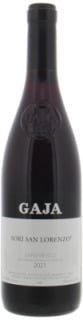
2021
€ 699,00 € 845,79 (in Vat) more info
Cellaring Potential
Sori San Lorenzo is best enjoyed between around 7 and 30 years after release. Its aging potential stems from a combination of high acidity and firm tannins characteristic of the Nebbiolo grape, as well as the concentration achieved through low yields on the southern slope of Sori. The young wine has a closed flavor profile with pronounced tannins, but this means the wine needs time to “rest.” Store it horizontally, protected from light, at a stable temperature of 12–14 °C and constant humidity.
FAQ
Why did the “Sori San Lorenzo” wine carry a Langhe DOC label for many years?
The reason is that Angelo Gaja added a small amount of Barbera to the blend, which was not permitted under the Barbaresco DOCG regulations. Starting with the 2013 vintage, this wine became 100% Nebbiolo and once again fell within the Barbaresco DOCG classification.
Is “Sori San Lorenzo” a Barolo wine?
No. It is a “Barbaresco” wine produced in the village of Barbaresco. Although it is made from the same Nebbiolo grape variety as Barolo, the designation of origin is different, and the wine’s style is slightly lighter than Barolo’s and more aromatic.
How long can “Sori San Lorenzo” be aged?
Under proper storage conditions, it can be aged for 20 to 30 years without any issues, and in the case of exceptional vintages, even longer.
Is “Sori San Lorenzo” a wine worth investing in?
Yes. Production is limited, demand is high worldwide, and prices for past Gaja vintages are steadily rising.
