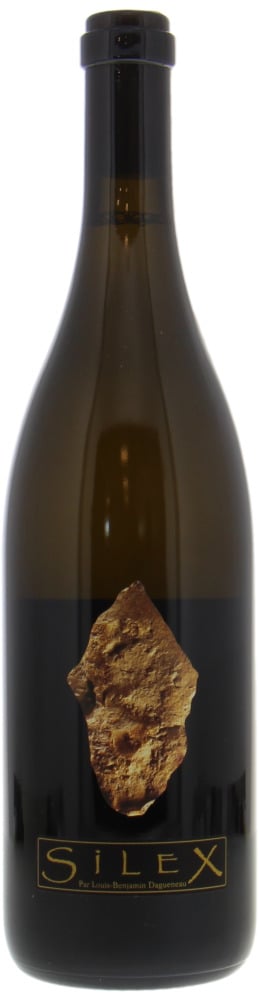

| Classification | Cru Classe |
| Type | White |
| Producer | Didier Dagueneau |
| Vintage | 2019 |
| Country | France |
| Region | Loire |
| Appellation | Pouilly-Fume |
| Grape | Sauvignon Blanc |
| Alcohol % | 13.5% |
| Volume | 0,75 |
| Condition | Perfect |
| Label | Perfect |
| Stock | 0 |
The 2019 growing season on the Loire has been hot and dry, with early spring frosts. For Didier Dagueneau's Silex variety, growing on old vines on siliceous soils atop the Saint-Andelain hill, this meant concentrated fruit and naturally low yields. Louis-Benjamin Dagueneau has managed the domaine since 2008, and the 2019 Silex reflects his stewardship.
The nose opens with smoke and flint, moving into grapefruit rind, white peach and chalky, salty flavors. On the palate, the 2019 is characterized by density. The warm vintage shows ripe citrus and stone fruit, but the acidity is still there and keeps everything even. Aging in barrels on lees gives a creamy weight without overt oak notes. The finish is long, mineral and slightly salty.
Silex is 100% Sauvignon Blanc. There are no blending partners or safety net here. So why does this grape work so well here? The flint (silex) soils of Saint-Andelain give Sauvignon Blanc something it rarely gets elsewhere. Old vines, 60 to 90 years old, add concentration.
The 2019 Silex is drinkable now, but we prefer to wait. This wine is notoriously slow to open up, and a full-bodied cuvée takes 10 years or more to reach its peak; it is best enjoyed in the 2026-2040 window; store at 12-14°C. With aging, you can expect honey, beeswax and deeper smoke to emerge.
Twelve hectares in Pouilly-Fumé. Didier Dagueneau built the estate from scratch in 1982, starting with 1.2 hectares in En-Chaille, and he was among the first in the region to ferment and age Sauvignon Blanc in oak, using it for texture rather than aroma. Yields sit at 50 to 75 per cent of what neighbours pick. Soils are still sometimes ploughed by horse, and harvesting is done by hand in several passes. Since his death in 2008, son Louis-Benjamin and daughter Charlotte have run things, and in 2018 they dropped the appellation and labelled the wines Vin de France. Plot by plot: Silex, Pur Sang, Buisson Renard, Astéroïde. But the Jurançon sweet wine Les Jardins de Babylone is the exception, made from Petit Manseng.
The name Silex derives from the soil found at the summit of Saint-Andelain Hill, located in Pouilly-Fumé. This soil consists of silica mixed with clay. Because flint soil drains quickly, the vines are never waterlogged, and ploughing, sometimes done with a horse, allows the roots to grow deep. The vines here are between 60 and 90 years old. The smoky aroma and the sharp edge in the wine, reminiscent of striking a match, stem not from any winemaking technique, but directly from this unique combination of factors.
Oak barrels were an element that had virtually no tradition in this region. Dagueneau borrowed the idea from Burgundy, but uses oak barrels not to impart aroma, but rather to enhance texture and promote contact with the lees. They use 320-liter cigar-shaped casks and 600-liter foudres (large oak barrels). Silex is aged with its lees for about 12 months without racking, then aged for several more months in tanks before bottling. Only indigenous yeasts are used, and no sugar is added nor acidity adjusted. Harvesting is done by hand in several passes, selecting only fully ripe fruit.
Serve with charcoal-grilled sea bass or dorade, garnished with lemon. It also pairs exceptionally well with octopus, as the wine's saltiness harmonizes beautifully with that of the dish. Crottin de Chavignol (a local goat cheese) is a classic pairing and remains one of the best combinations. If you're looking for something simpler, grilled shrimp is highly recommended.
With track & trace code