Mongeard-Mugneret
Vosne-Romanée is home to many famous wineries, and Mongeard-Mugneret is one of the most prolific among them. This domaine cultivates 30 hectares of vineyards across 37 different appellations, which is a very extensive range from Burgundy's perspective: five Grand Crus, ten Premier Crus, twelve village wines, and ten regional appellations, all produced from its base in the village itself.
As in other regions of Côte de Nuits, red wines predominate, but the domaine's portfolio also includes the white wines Bourgogne Blanc, Aligoté, and Crémant. The family has lived here for a long time, and the family emblem, Qualité Noblesse, engraved on the label, is not merely a slogan but a declaration that clearly expresses their intent.
Four centuries in one village
The founding of Mongeard-Mugneret dates back to 1620. As a result, this domaine is considered one of the oldest in the Vosne-Romanée region; like most Burgundian domaines established during that era, its history is based primarily on family records rather than notarized documents that anyone could pull off a shelf.
More important is the continuity that has followed. This domaine has always been run by the family, and the hyphenated name, a typical feature of Burgundy, indicates that two families have merged. Thanks to this pattern, the land in the Côte de Nuits region was acquired one parcel at a time over several generations, rather than being purchased all at once.
The estate's modern reputation was built on its Grand Cru wines. Bottles of the estate's Richebourg wines, dating back to the 1980s, are still found at tastings and auctions, which serves as a reasonable measure of how long these top-tier wines have been taken seriously even outside of Burgundy.
Thirty hectares, thirty-seven appellations
While 30 hectares is a considerable size by Côte d'Or standards, what truly characterizes Mongeard-Mugneret is the fragmentation of the land. These hectares are scattered across 37 appellations, resulting in small average plot sizes, with some plots being extremely small.
Most of the land is located in Côte de Nuits, distributed around Vosne-Romanée, Vougeot, Flagey-Echézeaux, Nuits-Saint-Georges, and Fixin. A smaller portion lies further south in the Côte de Beaune, at Beaune and Savigny-lès-Beaune.
The classification system is as follows:
- Four Grand Cru appellations
- Ten Premier Cru
- The Village appellations
- The regional appellations, which include Hautes Côtes de Nuits
Managing so many individual vineyards means dividing the harvest into dozens of small lots, each of which must be harvested and vinified separately. This is a time-consuming process and the price one pays for cultivating Burgundy's mosaic-like vineyards rather than a single, contiguous plot.
The terroir
Echézeaux is where the complexity inherent in this part of Côte de Nuits is most evident. This Grand Cru encompasses 11 lieux-dits and has approximately 60 different owners, many of whom own vineyards in more than one lieu-dit.
This results in two outcomes. Echézeaux bottled wines are often blends of grapes from multiple plots, and it is impossible to tell from the label alone which plots were used. In the past, some domaines used to list the names of individual lieux-dits on the Echézeaux label, but this is no longer permitted. Therefore, in the case of Echézeaux, the producer's name conveys more information than the appellation.
The same logic applies to the rest of Mongeard-Mugneret's estate. Vosne-Romanée, Vougeot, and Nuits-Saint-Georges each have their own unique slopes and soil conditions, and the domaine's role is not to homogenize these differences into a house style, but rather to clearly highlight their distinct characteristics.
Pinot first, but not only
Pinot Noir plays a major role in this area, ranging from Bourgogne and Hautes Côtes de Nuits to Richebourg. All red wines in the Côte de Nuits portfolio are Pinot, as are the Côte de Beaune wines produced from Beaune and Savigny-lès-Beaune.
Although white wine production is limited, it certainly exists. Chardonnay is used in Bourgogne Blanc and Crémant de Bourgogne, while other white grape varieties from Aligoté and Burgundy's are released as separate bottlings.
A notable exception in the product lineup is Bourgogne Passetoutgrain. This historic appellation permits the production of Gamay alongside Pinot Noir. Although many domaines have quietly ceased production of this type of wine, Mongeard-Mugneret continues to produce it.
The winemaking
Mongeard-Mugneret describes the winemaking process in an exceptionally humble tone. Nothing is treated as a set procedure; every step is adjusted to suit the specific vintage, and decisions are made based on what the wine itself suggests rather than following a predetermined recipe established before harvest.
This is evident in two practical ways. Each lot is managed individually throughout fermentation and aging, and is bottled and released only when the domaine deems it ready. In other words, the release schedule is adjusted to suit the wine, not the other way around.
From the vineyard to the wine cellar, manual labor is a key element in defining this domaine. It does not claim to reinvent Vosne-Romanée. Their ambition is narrower and more demanding: to ensure that the 37 appellations retain their unique flavors year after year.
The wines: from Aligoté to Richebourg
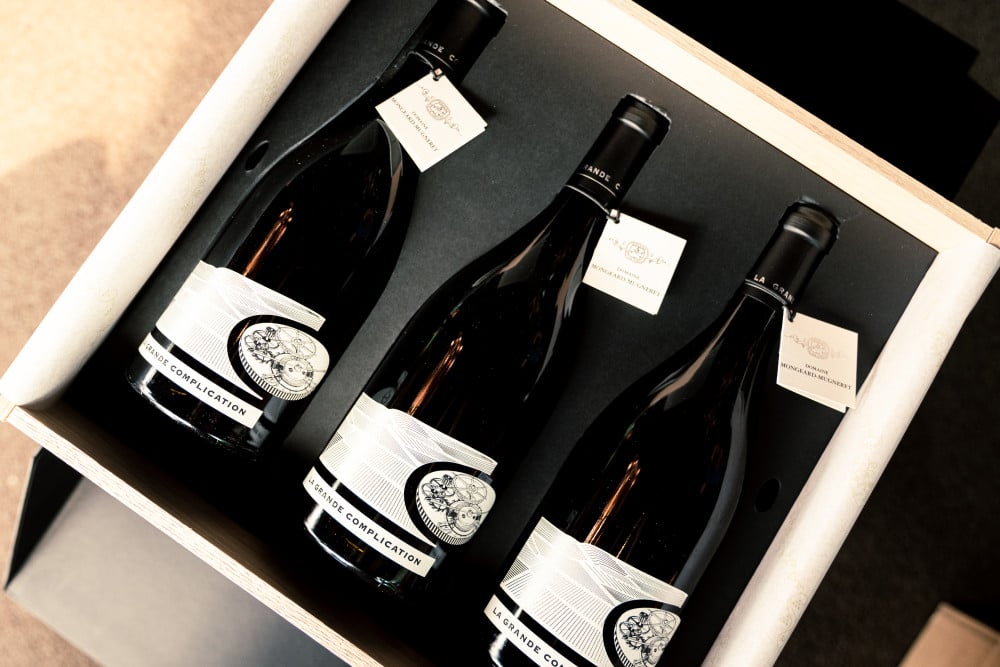
Mongeard-Mugneret is best known for its top-tier wines. There are a total of five Grand Cru wines, Richebourg, Grands Echézeaux, Echézeaux, La Grande Complication, and Clos de Vougeot, a total of five Grand Cru wines, all of which are red and belong to the Pinot Noir line.
Below that are the named vineyard wines, which include Côtes. These include three wines produced from Vougeot (1er cru, Les Cras, Les Petits Vougeots); Nuits-Saint-Georges through Boudots and Nuits-Saint-Georges Les Plateaux; Beaune Les Avaux 1er cru, Savigny-lès-Beaune 1er cru, Les Narbantons, Vosne-Romanée En Orveaux, and the standard village wine, Vosne-Romanée. Fixin Vieilles Vignes is produced from old vines located at the northern end of Côte de Nuits.
Furthermore, the range of wines for everyday enjoyment is much broader than most people would expect: Bourgogne-Hautes Côtes de Nuits Les Dames Huguettes, Bourgogne Passetoutgrain Le Libertin, Bourgogne Chardonnay, Bourgogne Aligoté, Cremant cuvee Chloe and Vin de France, known as Cuvée M.
That still does not represent the entirety of the domaine. Since it encompasses 37 appellations under one roof, there are always more wines in the cellar than are listed on any single wine list.
Frequently asked questions
Where is Domaine Mongeard-Mugneret based?
In Vosne-Romanée, in the Côte de Nuits. Its vineyards are concentrated around that village and its neighbours, with additional parcels further south in the Côte de Beaune at Beaune and Savigny-lès-Beaune.
Why don't Echézeaux labels name the individual vineyard?
Echézeaux is made up of 11 lieux-dits, but regulations no longer allow producers to state the specific one on the label. Some domaines did so in the past; today the wines are simply Echézeaux.
Does Mongeard-Mugneret make white and sparkling wine?
Yes. Alongside the reds there is a Bourgogne Chardonnay, a Bourgogne Aligoté and a Crémant de Bourgogne.
Is the domaine still family-owned?
Yes. Mongeard-Mugneret has remained a family estate since its founding, and the wines are made and bottled at the domaine in Vosne-Romanée.
Regions