

Desiderio
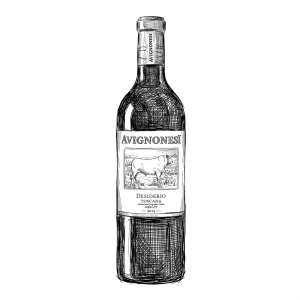
“Desiderio” is a pure Merlot produced by Avignonesi and bottled under the IGT Toscana designation. In other words, it is not a Vino Nobile. Nevertheless, it is precisely thanks to “Vino Nobile di Montepulciano” that the Avignonesi winery has earned its reputation. The decision to grow Merlot on the gentle hills between Montepulciano and Cortona and bottle it as a single-varietal wine is fully in line with the "Super Tuscan" tradition, which brought a breath of fresh air to the region in the 1970s and 1980s. However, “Desiderio” is not produced on the coast, where most of the famous Merlot is grown, but in southeastern Tuscany. Thanks to this inland location, it possesses characteristics that differ from the Merlot of Bolgheri, well known to many connoisseurs. Avignonesi practices biodynamic farming on around 175 hectares of vineyards, and “Desiderio” embodies the potential of the company’s Merlot vineyards in the form of a single-varietal wine.
About Avignonesi
Avignonesi manages one of Italy’s largest certified wineries that practices biodynamic agriculture. This is significant because biodynamic farming is typically practiced on small plots, and implementing it across 175 hectares of vineyards is a feat on an entirely different scale. This transition began in 2009, when Virginie Savéris acquired the winery and began its transformation. In 2016, she received organic certification; in 2019, biodynamic certification from Biodyvin; and in 2022, B Corp certification. In 2024, she handed the estate over to her children, Basil and Elin Aloi. We work with “Avignonesi” wine not only because almost no other producer of this scale dares to take this path, but also Avignonesi just makes excellent wines.
History & Heritage
The name “Avignonesi” dates back to a 16th-century family from Montepulciano, though the history of the modern winery began only in 1974. The founding brothers gained fame thanks to their “Vino Nobile di Montepulciano” and “Vin Santo” wines, as well as, in particular, the rare “Occhio di Pernice.” The turning point came with the sale of the winery to Virginie Savéris in 2009. Traditional “Vino Nobile” producers usually do not risk converting all their vineyards to biodynamic farming, and many producers from Montepulciano initially waited to see how it would work out. The result proved to be a success. Since 2013, all winemaking and aging processes have been moved to the Lodola estate, located a few kilometers from the historic “Le Capezzine” cellar. “Desiderio” is a wine that marks this new chapter.
Terroir & Climate
The vineyards are situated between Montepulciano and Cortona and stretch across clay-limestone soils at an elevation of about 300 meters above sea level. Clay has excellent water-retention capacity, which is an important factor, especially for the Merlot variety, which is vulnerable to drought. Limestone imparts acidity and lightness to the wine. The rest depends on the elevation above sea level. Warm days and cool nights, this is the typical diurnal temperature variation found in the hilly terrain of inland Tuscany. Lake Trasimeno, located just across the border with the Umbria region, moderates the climate and prevents excessive heat. As a result, Merlot from Desiderio has a firmer structure and greater freshness than wines produced in warmer coastal areas, such as Bolgheri. Its softness is restrained, and its flavor is dense and rich.
Grape Varieties
The blend is simple: 100% Merlot.
When it comes to Merlot in Italy, the coastal regions of Veneto and Bolgheri are most often mentioned. However, when grown on the clay-limestone soils of the high-altitude inland regions, a completely different wine is produced. The fruit flavor does not resemble the ripe jam typical of warmer regions, but rather leans toward notes of plum and black cherry. Due to the limestone, which accentuates the wine’s structure, the tannins are also more pronounced. Nevertheless, this is unquestionably a Merlot with a velvety texture and rich flavor, but with a more robust structure. Since the wine is made from a single variety, it lacks the Cabernet that would otherwise support its structure. The terroir must take on this role.
Winemaking
At Avignonesi, each plot is cultivated individually, and harvesting and winemaking are carried out separately for each lot. Only natural yeasts are used; no commercial yeast cultures are added to steer fermentation in a specific direction. “Desiderio” is aged using a wide range of methods employed at our winer, in barriques, large oak barrels, and, for other wines, sometimes also in concrete tanks and amphorae, however, this particular Merlot is aged in oak barrels to develop the structure that defines its character. It is precisely this minimalist approach that is crucial. Thanks to the use of grapes grown using biodynamic farming methods and wild yeast, this wine is intended to reflect not a “signature style” imposed by the winery, but the Lodola winery itself and the specific vineyard where this Merlot was grown.
Serving Suggestions
Serve at 16-18 °C. At higher temperatures, the alcohol will be too pronounced. Young vintages should be decanted for at least an hour to allow the tannins to mellow. Older vintages, aged for more than 10 years, need only be decanted for no more than 30 minutes. A standard Bordeaux glass is suitable; no special glasses are required.
Food Pairing
To bring out the flavor profile of “Desiderio,” pair it with dishes containing protein and a small amount of fat. Try the following dishes:
- Bistecca alla Fiorentina: a classic Tuscan bone-in steak. It should be seared to perfection on the outside and cooked “rare” on the inside.
- Pappardelle with wild boar ragù: the distinctive flavor of game harmonizes with the wine’s rich flavor.
- Roast duck with cherry sauce. The fruity notes of the sauce echo the creamy undertones of Merlot.
- Aged Pecorino Toscano. The saltiness softens the tannins.
Avoid dishes that are too delicate. White fish, pasta with a light sauce, salads, and the like will be overshadowed by the wine’s flavor.
Vintages
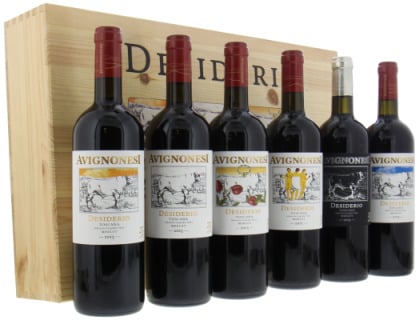
The differences between individual vintages are much more pronounced than with typical Merlot wines available in retail stores. In warm years in Tuscany, the fruit notes take on a hint of ripe plum, and the tannins become softer. At the same time, in cooler years, a firmer structure and spicy nuances come to the fore, requiring extended aging in the bottle. If you’re looking for a wine to taste directly, try to find a bottle that has been aged for at least 7–8 years. After all, that’s how long it takes for the tannins to round out.
If you’re storing wine in your cellar, look for vintages with a firmer structure. Old vintages of Desiderio, if you can find them, are generally sold at high prices due to limited production.
The best vintages of Desiderio
The level and quality of this wine is high. However, some exceptional recent vintages are:2018, 2021, 2022.
Cellaring Potential
The optimal drinking window is after around 5 years till 15 years after release. Although the tannins and acidity are capable of withstanding long-term aging, Merlot from the inland regions of Tuscany, unlike Cabernet-based wines, does not reveal its true value with indefinite aging. The fruity notes fade before the wine’s structure begins to deteriorate. Store at a stable temperature of 12–14 °C, away from light and vibration. As it matures, the aromas of plum and cherry evolve into notes of dried fruit, leather, and truffle, characteristic of aged Merlot.
