

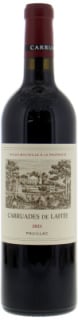
Carruades de Lafite Rothschild
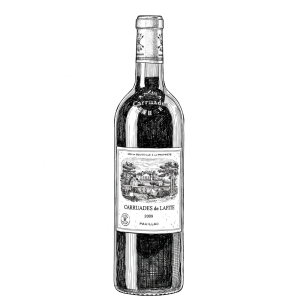
Carruades de Lafite is Château Lafite Rothschild's second wine; however, the term “second wine” does not fully reflect its true value. The grapes are grown primarily on the Carruades plateau, which the Rothschild family acquired in 1868 along with the main Lafite estate. In other words, this is not a wine of lesser status compared to the Grand Vin. It possesses its own character, unique to this vineyard.
In Carruades, the proportion of Merlot in the blend is usually higher than in the Grand Vin, giving them a rounder and more approachable flavor. Nevertheless, this is still Pauillac, where the soil consists of a deep layer of gravel resting on limestone. However, since this wine opens up more quickly than the Grand Vin, it does not need to be aged for long and can be enjoyed right away. We carry it in our selection because it is one of the few ways to enjoy Lafite’s Pauillac terroir without paying much more than for a “Grand Vin.”
About Chateau Lafite Rothschild
When Baron James de Rothschild bought the estate in 1868, Lafite was already at the top of the 1855 classification. Today, the estate is managed by Domaines Barons de Rothschild, and Saskia de Rothschild took over as chairwoman in 2018. Lafite Rothschild is the most restrained of the Pauillac First Growths, almost Burgundy like. Terroir & Climate Lafite Rothschild is characterized by deep gravel deposits overlying Tertiary limestone and marl. Why it matters. The gravel drains quickly and retains heat, allowing Cabernet Sauvignon roots to grow deeper in search of water and for the grapes to ripen evenly. The estate sits on a gravel mound, known locally as a croupe, which rises gently above the surrounding land. The nearby estuary of the Gironde mitigates the frosts and summer heat.
Lafite Rothschild's signature technique is to age the wine for 18-20 months in primarily French oak. The barrels are from the in-house Tonnellerie des Domaines workshop, and the toast and grain are specially selected for this wine. Fermentation takes place in wooden vats, stainless steel and concrete tanks, and malolactic fermentation takes place in tanks before transfer to barrels. Concentration and restraint. This is the hallmark of Lafite Rothschild.
History & Heritage
The Carruades plateau was part of the land acquired in 1868, when Lafite passed into the hands of the Rothschild family. Baron James paid 4,140,000 francs for the Lafite estate itself and another 300,000 francs for the adjacent Carruades lands. He died three months later, and his entire estate was inherited by his three sons.
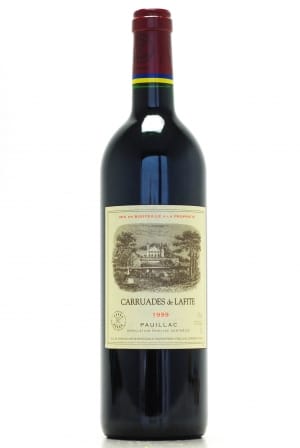
For most of its history, Carruades de Lafite was considered a “second wine” to Lafite. However, in the 2000s, especially as demand for Bordeaux second wines grew in Asian markets, the situation changed dramatically. Prices rose, and the wine began to attract attention. As a result, it came to be seriously appreciated not merely as a way to acquire a wine bearing the “Lafite” label at an affordable price, but as a wine in its own right. Older vintages, such as those from 1999 and 2007, available in our store, clearly demonstrate how this wine has evolved.
Terroir & Climate
The Carruades plateau is located west of the château and lies on a layer of gravel, both shallow and deep, characteristic of the left bank of Pauillac. Beneath it lies a deep layer of limestone, which provides drainage. In some places, the gravel layer reaches a depth of 10 meters, forcing the grapevines’ roots to penetrate deep into the soil in search of moisture and nutrients. It is precisely this deep root system that gives the grapes their richness.
However, the Carruades plateau is not quite like the slopes surrounding the château. They are located slightly away from the Gironde River, and their soil composition is suited to increasing the proportion of Merlot. Therefore, Carruades wines have a higher proportion of Merlot than the Grand Vin, which gives them a rounder flavor.
Grape Varieties
Carruades is a blend of Cabernet Sauvignon and Merlot, with a higher proportion of Merlot than in Lafite’s Grand Vin. The exact proportions vary depending on the vintage, but the general trend remains the same. The higher the proportion of Merlot, the softer the tannins and the sooner the wine reaches its peak drinking window. Cabernet Sauvignon continues to contribute the structure, blackcurrant aroma, and graphite-like sharpness characteristic of Pauillac. Merlot enriches the palate with plum notes and roundness. It is precisely this balance that allows Carruades to reach its peak of maturity earlier than most other First Growth Pauillac wines.
Winemaking
Grape fermentation takes place at a temperature of 26–27 °C in a combination of wooden, stainless steel, and concrete tanks and lasts about 15 days. Temperature control is important because Cabernet from Pauillac contains strong tannins, and if the fermentation temperature is too high, harsh and immature tannins are extracted. Thanks to proper temperature control, the tannins that make it into the bottle will not be aggressive but will possess a mature character and a robust structure.
After malolactic fermentation, all barrels are tasted individually. Wines not selected for “Grand Vin,” or those better suited to the "Carruades" style, are included in the "Carruades" blend. The wine is then aged in French oak barrels crafted in the estate's own cooperage, "Tonnellerie des Domaines," in Poyac. Compared to “Grand Vin,” the proportion of new barrels used here is lower.
Food Pairing
"Carruades," while possessing the robust structure characteristic of Pauillac, has a softer flavor than “Grand Vin,” which broadens the range of food pairing possibilities. Recommended pairings:
- Roast lamb with rosemary and garlic. A classic pairing with Pauillac wines
- Ribeye steak, simply sprinkled with salt. The fat in the beef softens the tannins
- Duck breast in a red wine sauce
- If you’d like to enjoy a cheese platter, try aged “Comté” or hard sheep’s-milk cheeses
Serve at 16–18 °C. It also pairs well with braised beef stew. It pairs especially well with aged vintage wines that feature pronounced earthy aromas and tobacco notes.
Serving Suggestions
Serve at 16–18 °C. At higher temperatures, the alcoholic aftertaste becomes more pronounced. Young vintages (2021, 2023) should be decanted for at least 90 minutes to allow contact with air. For aged wines, such as the 1999 vintage, short decanting is sufficient, but be mindful of the sediment when pouring. A standard Bordeaux glass is sufficient; no special glasses are required.
Vintages
Carruades accurately reflects the character of the Pauillac vintage but reaches its peak drinking window earlier than the Grand Vin. In warm years, such as 2023, the influence of the Merlot variety is more pronounced, giving the wine a dense and fruity flavor. In cooler, more classic years, such as 1999, Carruades develops a firm structure and merits extended aging. The 2007 vintage occupies a middle ground: it’s a wine that can be enjoyed young, yet already displays tertiary aromas such as cedar and tobacco.
If you want to enjoy the wine right now, try to find bottles from slightly older vintages, such as those from the second half of the 1990s or around 2007. Recent vintages, such as 2021 or 2023, are suitable for long-term aging, as they possess sufficient structure to withstand 10 to 15 years of aging.
Chateau Lafite Rothschild
2007
€ 225,00 (ex Vat) € 272,25 (in Vat) more info
Chateau Lafite Rothschild
2023
€ 174,00 (ex Vat) € 210,54 (in Vat) more info
Chateau Lafite Rothschild
1999
€ 199,00 (ex Vat) € 240,79 (in Vat) more info
Chateau Lafite Rothschild
2021
€ 195,00 (ex Vat) € 235,95 (in Vat) more info
Cellaring Potential
Thanks to the structure of Cabernet Sauvignon and the concentration imparted by the gravelly soils of Pauillac, Carruades opens up more quickly than Grand Vin, yet still possesses significant aging potential. Store at a temperature of 12–14 °C in a moderately humid environment. Changes over time: primary aromas such as black currant and plum recede into the background, while notes of cedar and tobacco come to the fore, and the texture of the tannins shifts from dense to silky. These changes are well worth the wait.
FAQ
Is Carruades de Lafite the same wine as “Château Lafite Rothschild”?
No. Carruades is a second wine produced primarily from grapes grown on the Carruades plateau, and it contains a higher proportion of Merlot than Lafite’s Grand Vin.
Is Carruades de Lafite a good investment?
Yes, especially for outstanding vintages. Since the 2000s, prices have risen significantly due to demand from Asian buyers.
How long can Carruades de Lafite be aged?
If it’s a good vintage, it can be aged for 20 to 25 years without any issues.
Why is "Carruades de Lafite" cheaper than "Lafite"?
This is because the vineyards are located on a different plot, the blend contains more Merlot, fewer new barrels are used, and there is less market pressure. This does not mean the quality is inferior, it is simply a different wine with different characteristics.
