
50 years later: the Judgment of Paris, 1976
On a warm May day in 1976, several of France's most respected wine experts gathered at a Paris hotel for a tasting that they were sure would be an easy comparison or perhaps even a competition. But that was not the case.
The story of the ‘Judgment of Paris’ begin not with a Frenchman, but with an Englishman, and not in a luxurious castle, but in a modest wine shop tucked away in the 1st arrondissement of Paris.
Here you will find the story of that legendary tasting, which changed the perception that centuries-old traditions or a European address are not necessary to create a great wine...
How it All Started
Steven Spurrier had moved to France in the early 1970s with the kind of enthusiasm for French wine that only an outsider could have. He opened a shop called Les Caves de la Madeleine and, alongside his American colleague Patricia Gallagher, founded a wine school called L'Académie du Vin. By 1976 the school was doing well, and Spurrier had built a solid reputation in the city's wine circles. He sold almost exclusively French wine. He believed in French wine. He did not, if we're being honest, think very much was going to come of what he was planning for May 24th.
The idea for the tasting had actually come from Gallagher. She had spent time in California's Napa Valley in September 1975 and had come back genuinely impressed by what she tasted. She and Spurrier had previously run small American wine tastings at the school each July 4th, sourcing bottles from embassies. But 1976 was the bicentennial of American independence, and Gallagher felt it was time to do something bigger: something that would properly introduce California wines to the people in Paris who shaped how the world thought about wine.
In March 1976, Spurrier flew to California to pick the wines himself. He visited wineries across the Napa Valley, bought two bottles of each wine he liked, and came home with what turned out to be too much luggage. The California wines were eventually brought to Paris tucked into the baggage of a visiting tour group, as a favour.
The Setup of the Tasting
The tasting was held on May 24, 1976, at the InterContinental Hotel in Paris. It was set up as a straightforward blind tasting, the bottles were wrapped so no one could see the labels, and the judges were asked to score each wine out of 20 points. No framework was given for how to award those points. They were simply told to taste and score.
There were two separate flights. The first was white wines: six California Chardonnays tasted against four white Burgundies, all also made from Chardonnay. The second was reds: six California Cabernet Sauvignons up against four top Bordeaux wines.
It's worth noting something that Gallagher herself pointed out years later. This was not originally conceived as a competition. "The whole thing was in no way conceived of as a comparative tasting or a competition," she told the San Francisco Chronicle in 2018. "It was educational. We just wanted to share what we found in California with people we respected." The blind element was actually a late addition — Spurrier decided to wrap the bottles when he realized that most of the judges would be unfamiliar with California wines and didn't want their opinions to be influenced by seeing an unknown label.
The judges themselves were not people you could underestimate. Nine of the eleven present had their scores counted in the final results (Spurrier and Gallagher scored the wines too, but their scores were excluded from the official tally). Among the nine were: Pierre Brejoux, inspector general of the Appellation d'Origine Contrôlée board; Odette Kahn, director of La Revue du Vin de France; Aubert de Villaine, co-director of the Domaine de la Romanée-Conti; Christian Vannequé, head sommelier of La Tour d'Argent; Raymond Oliver, owner of the legendary Le Grand Véfour restaurant; Jean-Claude Vrinat, owner of Taillevent; and Pierre Tari, owner of Château Giscours in Bordeaux. These were not people who were going to get fooled by marketing. They knew wine.
The Wines that were Compared
The wines that were poured that afternoon were.
White wines — California Chardonnays:
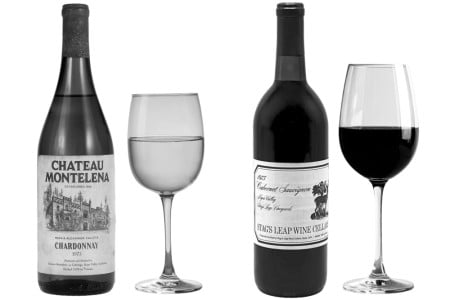
- Chateau Montelena 1973
- Chalone Vineyard 1974
- Spring Mountain Vineyard 1973
- Freemark Abbey Winery 1972
- Veedercrest Vineyards 1972
- David Bruce Winery 1973
White wines — French Burgundies (Chardonnay):
- Meursault Charmes Roulot 1973
- Puligny-Montrachet Les Pucelles Domaine Leflaive 1972
- Beaune Clos des Mouches Joseph Drouhin 1973
- Bâtard-Montrachet Ramonet-Prudhon 1973
Red wines — California Cabernet Sauvignons:
- Stag's Leap Wine Cellars 1973
- Ridge Vineyards Monte Bello 1971
- Heitz Wine Cellars Martha's Vineyard 1970
- Mayacamas Vineyards 1971
- Clos Du Val Winery 1972
- Freemark Abbey Winery 1969
Red wines — French Bordeaux:
- Chateau Mouton-Rothschild 1970
- Chateau Haut-Brion 1970
- Château Montrose 1970
- Château Léoville-Las-Cases 1971
The French wines were of course among the most prestigious in the world. Mouton-Rothschild and Haut-Brion are two of the five so-called "First Growths". The Burgundy whites from Leflaive and Roulot were also high class. Against them, the California wines were essentially unknowns. The 1972 vintage from Clos Du Val was actually that winery's first ever vintage. Chateau Montelena, which was to become famous that day, had only been making wine since 1972. Its winemaker was a Croatian-born immigrant named Miljenko "Mike" Grgich, who had learned his craft in the Napa Valley over the previous two decades.
The Tasting
Spurrier announced the results of the white wine flight before the red wines were tasted. What he said stopped the room: the judges had not given top marks to a French Burgundy. They had given them to the 1973 Chardonnay from Chateau Montelena in Calistoga, California. It had scored 132 points in the combined tally of the nine judges. The runner-up, with 126.5 points, was the French Meursault Charmes Roulot. Importantly, California wines also took third and fourth place: Chalone Vineyard in third and Spring Mountain Vineyard in fourth. The highest-ranked French wine after the runner-up was the Puligny-Montrachet Les Pucelles from Domaine Leflaive, in fifth.
There was reportedly a cold silence in the room when Spurrier read out those results.
Then came the reds.
Knowing now that the whites had gone to California, the judges were said to be determined to restore the natural order with the reds. The Bordeaux were famous. Everyone at the table knew Mouton-Rothschild and Haut-Brion even if they couldn't see the labels on the bottles. Surely the reds, at least, would come back home to France.
They didn't.
The winner in the red flight was the 1973 Stag's Leap Wine Cellars Cabernet Sauvignon from Napa Valley, with 127.5 points. Second place went to Château Mouton-Rothschild 1970, with 126 points: a gap of only 1.5 points, it's true, but second place nonetheless. Third was Château Montrose 1970, fourth was Château Haut-Brion 1970, and fifth was Ridge Vineyards Monte Bello 1971. So two of the top five reds were Californian. Of the six California reds, only two finished in the bottom half of the overall rankings.
Warren Winiarski, the owner and winemaker of Stag's Leap, was not at the tasting. None of the California winery owners or winemakers were present. The first he heard of it was by telephone.
The Only Reporter in the Room
Steven Spurrier had invited quite a few journalists to come and watch. Almost none of them showed up: a blind tasting of wines from a country that nobody in the French wine world took particularly seriously did not seem like a great story on a Wednesday in May.
The one exception was a young American named George M. Taber, who worked for Time magazine's Paris bureau and had actually been attending Spurrier's wine school. He was there, he took notes, and he wrote a short piece about what had happened. It ran in the July 7, 1976 issue of Time, buried on page 58, next to an advertisement for Armstrong Tires, and it was published without a byline. It was only four paragraphs long. But in those four paragraphs, Taber coined the phrase that would stick: drawing on the ancient Greek myth in which the Trojan prince Paris had to judge between three goddesses, he called the event the Judgment of Paris. He also wrote that "the unthinkable happened."
The French wine press, which was not at the tasting, responded with a combination of dismissal and irritation. The country's major wine publications and newspapers largely ignored the story, and those that did cover it were sceptical. Some questioned whether the tasting had been set up fairly. Several Bordeaux producers complained that their wines were too young: the 1970 reds had only been open for six years, which for a top Bordeaux is nowhere near maturity. The French wine establishment, to put it mildly, was not pleased.
What It Meant
In California, the phones started ringing. Stag's Leap Wine Cellars, a small operation that had only produced its first wine in 1972, suddenly found itself fielding calls from across the world. Warren Winiarski would eventually sell the property for $185 million in 2007. Mike Grgich, the winemaker behind the winning Montelena Chardonnay, left to found his own winery, Grgich Hills, in 1977. It is still going today.
Before the Paris tasting, there were less than 70 wineries in the Napa Valley. By the time of this writing, there are over 400.
The result also opened a broader question: if California could beat France, what else was possible? The Judgment of Paris established a template for what became known as Old World versus New World tastings. It gave a structure and a language to the idea that great wine did not require centuries of tradition or a European address. Australia, South Africa, Chile, Argentina, New Zealand: all of them benefited, over the following decades, from the crack in the wall that Paris 1976 had made.
The connection between the Paris tasting and the emergence of international wine culture is not imaginary. In 1979, just three years after the tasting, Robert Mondavi of Napa Valley and Baron Philippe de Rothschild of Mouton-Rothschild announced a joint venture to produce a wine together in the Napa Valley. It was called Opus One, and its first vintage was 1979. The symbolism could not have been more deliberate.
The Rematch: and What It Showed
The French judges had, almost immediately after the tasting, offered a counter-argument: the California wines were big and showy and would not age. Give it ten years, they said, and the French wines would have opened up and surpassed the Americans. In 1978, just twenty months after the original event, Spurrier flew to San Francisco for a follow-up tasting at the Vintners Club. The same wines were tasted again. The California reds and whites again came out on top: Stag's Leap first among the reds, Chalone first among the whites.
The more significant rematch came in 2006, on the 30th anniversary of the original tasting. Spurrier organised simultaneous events in London and in Napa, this time with panels of internationally respected experts. The wines were now thirty years old, and this should have been the moment for the French reds to finally show the superiority of age that their producers had always claimed. It wasn't. The wine that came out on top in both the London and Napa tastings was Ridge Vineyards Monte Bello 1971: one of the California reds from the original event, which had only placed fifth in 1976. The combined result put it eighteen points clear of the second-place wine. The Mouton-Rothschild and Haut-Brion, which had been expected to age magnificently, finished lower.
Bottles of the winning 1973 Stag's Leap Cabernet Sauvignon and the 1973 Chateau Montelena Chardonnay, bottles like the ones tasted that day in Paris, are now part of the permanent collection at the Smithsonian's National Museum of American History in Washington, D.C.
A Few Things to Keep in Mind
It would be easy to read the Judgment of Paris as a simple story of American triumph over French snobbery, and that version has been told many times. But it's a bit more complicated than that.
For one thing, the margins were small. The gap between the winning Stag's Leap and second-place Mouton-Rothschild in the reds was 1.5 points out of a combined total of over 120. These were not normal French wines; they were excellent bottles that lost by a whisker. For another, Aubert de Villaine, the co-director of Romanée-Conti and one of the most eminent figures in French wine, was himself one of the judges and he was perfectly happy to admit what he had tasted and scored.
It also bears repeating what Patricia Gallagher said: this was never meant to be a competition. Spurrier was not trying to humiliate French wine. He genuinely liked and respected it. He ran a French wine shop. The event was, at its core, an attempt by two people who were excited about California wines to share that excitement with knowledgeable friends. The result surprised everyone, including Spurrier.
The event also wasn't entirely ignored by criticism. Some statisticians later pointed out that when the scores of all eleven judges, including Spurrier and Gallagher, were included, the rankings shifted somewhat, and that only the top two wines in each category could be considered statistically distinguishable from the others. The competition, in other words, was genuinely close throughout.
But none of that changes the core fact of what happened on May 24, 1976, in a hotel in Paris: nine of the finest palates in the French wine world tasted twenty wines blind, and when the scores were counted, California was at the top of both lists. George Taber was there to write it down, the rest of the world eventually read about it, and wine was never quite the same again.
